
Skin concerns · Pigmentation

Melasma & Dark Spots: Diagnosis and Treatment in Myeongdong & Jongno, Seoul

Melasma, sun spots, freckles and post-acne marks look similar but behave very differently under a laser. At Obliv Clinic Seoul Origin a doctor identifies each type of pigment and its depth before choosing gentle toning, targeted spot treatment or creams.

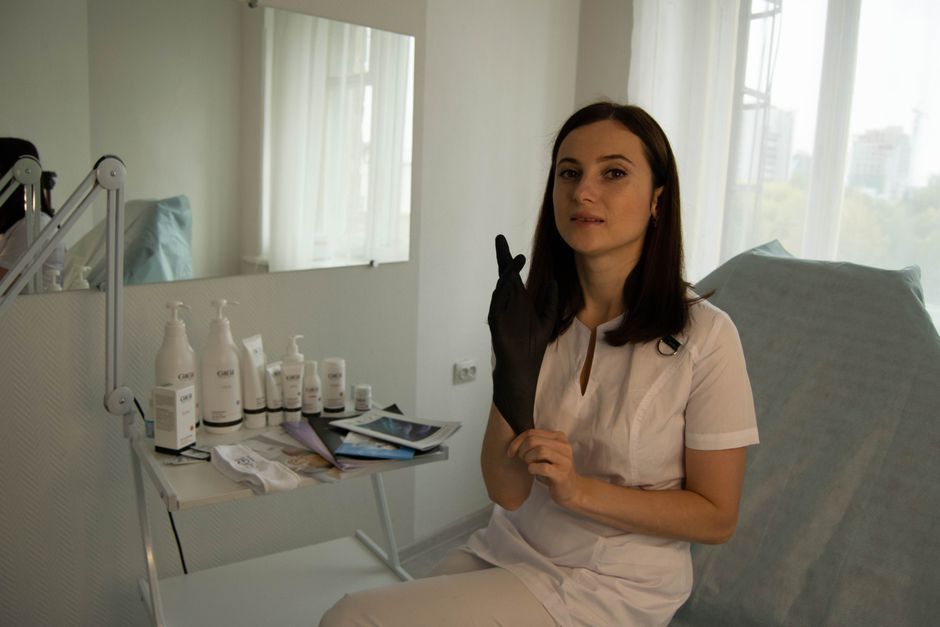
Patient at a melasma and dark spot consultation at Obliv Clinic near Myeongdong, Seoul

Quick answer

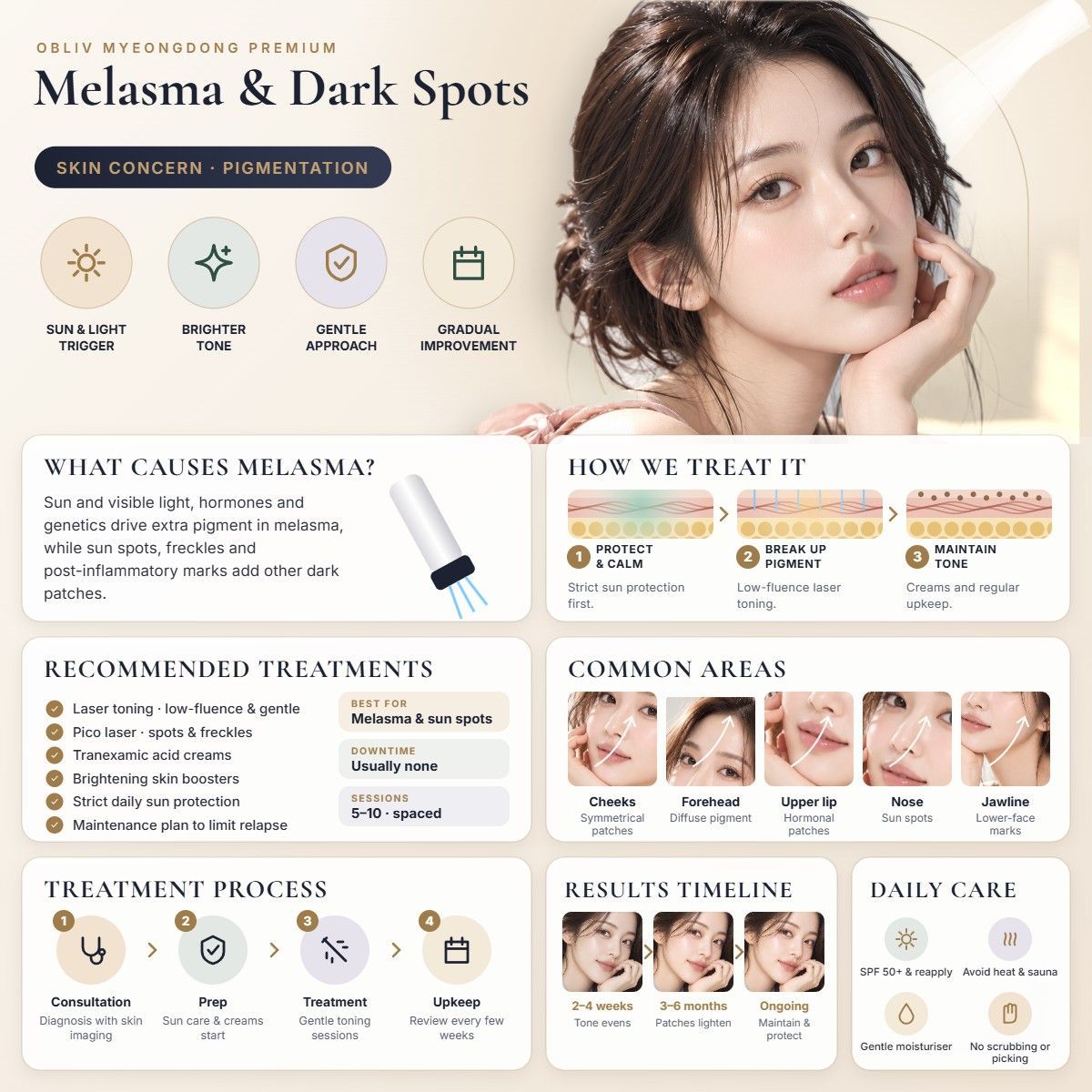
Melasma is a common, harmless pigment condition that causes symmetrical brown or grey-brown patches on the cheeks, forehead, upper lip and jaw, driven by sun and visible light, hormones and genetics. Dark spots also include sun spots (solar lentigines), freckles and post-inflammatory marks. Melasma needs a gentle, combined plan: strict sun protection, creams such as tranexamic acid or hydroquinone and, for selected patients, low-fluence laser toning, with improvement usually over 3–12 months. At Obliv near Myeongdong and Jongno, Seoul, a doctor maps each pigment type and depth first.

TimeAssessment about 30–45 min
DowntimeSpots: small scabs for ~1 week
SessionsToning: often 5–10 sessions
LastsMelasma can relapse; maintain

Key takeaways

  • Melasma is not the same as sun spots: spots often clear with targeted laser, while melasma is chronic, can relapse and can darken if treated too aggressively.
  • Sun and visible light are the biggest triggers; a broad-spectrum, tinted sunscreen containing iron oxides is part of every melasma plan.
  • Creams and tablets (tranexamic acid, hydroquinone combinations, azelaic acid) are first-line; lasers help most when combined with them.
  • Low-energy laser toning works gradually over a series; deep or patchy pigment may need a slower plan and expert settings.
  • Results usually take 3–12 months, and summer sun often brings some pigment back, so maintenance is normal.

What causes melasma and dark spots?

Skin colour comes from melanin, made by pigment cells called melanocytes in the base of the epidermis. Dark spots appear when melanin is produced in excess in one area, when melanocytes cluster, or when pigment drops into the deeper dermis. The trigger and the depth determine how a mark looks and, more importantly, how it responds to treatment.

Melasma is thought to be a light-driven disorder in genetically predisposed people. UV, visible light and heat stimulate melanocytes; hormones such as oestrogen and progesterone add fuel, which is why melasma often starts in pregnancy (the 'mask of pregnancy') or with hormonal contraception. Around 60% of patients have family members with melasma. It is much more common in women and in medium skin tones, including many East Asian, South Asian, Middle Eastern and Latin American patients.

Other dark spots have simpler stories. Solar lentigines (sun or age spots) are flat, well-defined brown marks caused by years of UV. Freckles are small, genetically determined spots that darken in summer. Post-inflammatory hyperpigmentation (PIH) is the brown mark left behind after acne, eczema, burns or an over-aggressive treatment, and it is especially common in darker skin.

Skin Architecture view: pigment in the epidermis usually lightens faster; pigment in the dermis is slower and needs gentler, longer plans. Knowing the depth before treatment avoids the rebound darkening that frustrates so many melasma patients.
Which skin layer Melasma & Dark Spots targets epidermis: Most sun spots, freckles and epidermal melasma sit here; these respond best to treatment.; dermis: Dermal or mixed melasma and Hori's naevus lie deeper, respond slowly and need cautious, expert settings. SKIN ARCHITECTURE · TARGET LAYER MAP Epidermis 0.05–0.1 mm Most sun spots, freckles and epidermal melasma sit here; these respond best to treatment. Dermis (collagen & elastin) 1–3 mm Dermal or mixed melasma and Hori's naevus lie deeper, respond slowly and need cautious, expert settings. Subcutaneous fat 3–4.5 mm+ SMAS (fibromuscular layer) ≈ 4.5 mm Muscle deeper Schematic, not to scale. Depths vary by face area, age and skin type; your doctor sets them after examination.
Skin Architecture view: the layers Melasma & Dark Spots works on.

How a doctor tells melasma apart from other dark spots

Many visitors arrive with several types of pigment on the same face: melasma across the cheeks, a few sun spots near the temples and some post-acne marks on the jaw. Each needs a different setting, so diagnosis comes first. Your doctor examines the pattern, colour and edges, uses dermoscopy to look below the surface, and reviews Mark-Vu skin analysis images that separate surface pigment from deeper brown and highlight UV damage that is not yet visible.

A Wood's lamp can help classify melasma: epidermal pigment looks more obvious under it, dermal pigment does not. A biopsy is rarely needed but may be suggested if a lesion is unusual. The table below shows the look-alikes our doctors consider most often.

Pigment type Typical look Usually treated with
Melasma Symmetrical blotchy patches on cheeks, forehead, upper lip; worse in summer SPF, creams, tranexamic acid, gentle laser toning
Sun spots (solar lentigines) Flat, sharply defined brown spots on sun-exposed areas Targeted pico or Q-switched laser
Freckles (ephelides) Small light-brown dots, darker in summer, from childhood Spot laser, then strict sun protection
Post-inflammatory marks (PIH) Brown marks where acne or irritation used to be Treat the cause, creams, gentle toning; see acne
Hori's naevus (ABNOM) Grey-blue or brown dots on both cheeks, often from adulthood Several deeper-reaching laser sessions
Seborrhoeic keratosis Slightly raised, 'stuck-on' brown spots Laser or other removal after confirmation

Which skin layers are involved

Most freckles, sun spots and many cases of melasma sit mainly in the epidermis, within roughly a tenth of a millimetre of the surface. Pigment here can be shed as the skin renews and responds to topical treatment and lasers relatively quickly. That is why a typical sun spot often clears after one or two targeted sessions.

In dermal and mixed melasma, melanin has dropped below the epidermis into the dermis, where it is taken up by scavenger cells and cleared slowly. Research also suggests that melasma skin shows changes in small blood vessels and the basement membrane, and signs of chronic light damage, which may explain why it keeps coming back. Deeper pigment such as Hori's naevus needs higher energy aimed deeper, but with careful spacing to avoid post-inflammatory darkening.

The figure below summarises how a pigment assessment and plan typically run. Session counts are guides; your doctor adjusts them to how your skin responds.

Melasma & Dark Spots at a glance Treatment time: Assessment about 30–45 min; Comfort / numbing: Toning: mild snaps, usually none; Downtime: Spots: small scabs for ~1 week; Typical sessions: Toning: often 5–10 sessions; Results appear: Gradual over 1–3 months; Results last: Melasma can relapse; maintain AT A GLANCE · OBLIV MYEONGDONG Melasma & Dark Spots TREATMENT TIME Assessment about 30–45 min COMFORT / NUMBING Toning: mild snaps, usually none DOWNTIME Spots: small scabs for ~1 week TYPICAL SESSIONS Toning: often 5–10 sessions RESULTS APPEAR Gradual over 1–3 months RESULTS LAST Melasma can relapse; maintain
Melasma & Dark Spots at a glance at Obliv Myeongdong. Ranges are typical; your doctor confirms them for your skin.

Ask a doctor about Melasma & Dark Spots

Send a photo and your travel dates on WhatsApp (+82-10-3086-4084). English replies, a personal plan and a written quote before you fly.

Treatment options for melasma and dark spots compared

Melasma is managed rather than cured. Dermatology guidance from the AAD and DermNet places sun protection and topical treatment first: a combination of hydroquinone, a retinoid and a mild steroid is among the most successful regimens, with tranexamic acid (cream or tablets) used when others are not enough. Laser and light treatments can improve results when combined with these, but the AAD stresses that they should be performed by experienced doctors.

In Korea, low-fluence Q-switched Nd:YAG and picosecond laser toning are widely used for melasma in Asian skin. Studies show useful improvement over a series, but also highlight relapse after stopping and, if energy or frequency is too high, mottled white spots (hypopigmentation) or rebound darkening. Our doctors therefore use conservative settings, space sessions thoughtfully and combine toning with home care rather than relying on the laser alone.

Option Best for How it works Typical plan Cautions
Laser toning(low-fluence Nd:YAG / pico) Melasma, diffuse uneven tone Low-energy pulses break up pigment gradually 5–10 sessions, 1–2 weeks apart Over-treatment can cause rebound or white spots
Targeted pico or Q-switched spot laser Sun spots, freckles, some marks Higher energy on individual spots 1–2 sessions Small scabs ~1 week; avoid on melasma patches
Pico Fraxel Scattered pigment with texture or scars Fractional micro-injury plus remodelling 3–5 sessions Not first choice for active melasma
Brightening programme Dull, blotchy tone Toning combined with boosters and care Series over 2–3 months Results depend on daily SPF
Prescription creams and tablets All melasma Tranexamic acid, hydroquinone triple cream, azelaic acid Daily for 3–12 months Doctor-supervised; clot history must be disclosed
Rejuran/ exosome support Thin, sun-damaged skin around pigment Supports dermal repair and barrier 2–3 sessions Supportive, not a pigment remover

Is it melasma, or a spot to check first?

Melasma and sun spots are harmless, but some skin cancers, including melanoma, can start as a brown mark. Any spot that is new and growing, changes shape or colour, has irregular edges, bleeds or does not heal should be examined before cosmetic treatment. Lasers must never be used on a lesion that has not been assessed, because they can mask warning signs.

Some pigment has medical causes, such as certain medicines, thyroid problems or, rarely, adrenal conditions that cause general darkening with tiredness and low blood pressure. If your dark patches came with other symptoms, or after starting a new medicine, tell us. We may suggest blood tests at home or referral to a dermatologist or endocrinologist.

Do not treat an unexamined mole or changing spot with laser. Show it to a doctor first; a biopsy may be needed to rule out skin cancer.
Signs it may be melasma vs See a doctor promptly if: Melasma & Dark Spots Good fit: Symmetrical brown patches on both cheeks, forehead or upper lip; Patches that darken in summer and lighten in winter; Started or worsened with pregnancy or hormonal medicine; Edges are blotchy rather than sharply defined; Family members have similar facial pigment. Not ideal: A single spot that is growing, changing or very dark; A mark with irregular edges or several colours; A spot that bleeds, itches or does not heal; New dark lines under a nail or on the palms; Darkening with tiredness, weight loss or low blood pressure. ✓ Signs it may be melasma ✕ See a doctor promptly if Symmetrical brown patches on both cheeks, forehead or upper lip Patches that darken in summer and lighten in winter Started or worsened with pregnancy or hormonal medicine Edges are blotchy rather than sharply defined Family members have similar facial pigment A single spot that is growing, changing or very dark A mark with irregular edges or several colours A spot that bleeds, itches or does not heal New dark lines under a nail or on the palms Darkening with tiredness, weight loss or low blood pressure
Melasma & Dark Spots: typical signs versus reasons to see a doctor promptly. Only an examination confirms the diagnosis.

How Obliv plans a pigment treatment

Our Skin Architecture approach treats pigment by type and depth. The doctor marks melasma zones, discrete sun spots and post-inflammatory marks on a face map. Melasma zones receive low-energy laser toning; isolated sun spots outside those zones can receive a targeted pico or Q-switched pulse; texture with scattered pigment may suit Pico Fraxel later.

Home care is half the plan. We set up a routine with a tinted mineral sunscreen containing iron oxides, which also blocks visible light, and, where appropriate, a brightening cream or oral tranexamic acid prescribed after checking your history. Patients with a history of blood clots, some heart conditions or who are pregnant are not prescribed tranexamic acid tablets.

Every setting and every photo is stored in your Skin Library, which is particularly useful for melasma: if a session leads to darkening, the next doctor knows exactly which energy and interval to avoid. For dark lips or a dull overall tone, related programmes include lip brightening and our skin brightening plan.
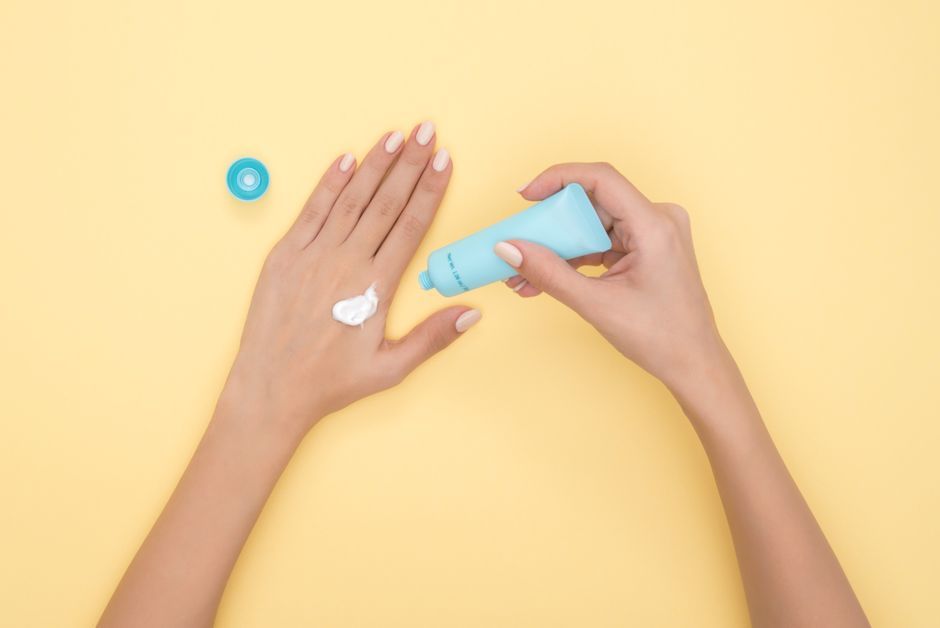
Applying sunscreen, the foundation of every melasma plan at Obliv near Myeongdong
Sun and visible-light protection is half of every pigment plan.

A typical treatment plan and timeline

Pigment treatment rewards patience. The AAD notes that melasma results usually take three to twelve months. Toning sessions are typically one to two weeks apart, and the most visible change often comes in the second and third month. Sun spots treated with a targeted laser darken, form tiny scabs and flake off within about a week, leaving pink skin that settles over a few weeks.

Short-stay visitors can usually have the assessment, a first toning session and any sun-spot treatment during one trip, then continue creams at home. Our guide can pigmentation be treated in three days? explains what is realistic, and the best season for pigmentation laser in Seoul covers timing.

Melasma & Dark Spots: typical treatment plan Visit 1: Mark-Vu pigment imaging, dermoscopy, diagnosis by type and depth, and a written plan.; Week 0–4: Daily tinted SPF, home creams and, where suitable, oral tranexamic acid from a doctor.; Week 2–4: Toning sessions begin at low energy; isolated sun spots may be treated separately.; Month 2–3: Tone looks more even; settings adjusted to how your skin responds.; Month 4–6: Series completed; review photos and switch to a maintenance routine.; Each summer: Expect some return; protect strictly and book a short top-up if needed. TYPICAL TREATMENT PLAN 1 Visit 1 Mark-Vu pigment imaging, dermoscopy, diagnosis by type and depth, and a written plan. 2 Week 0–4 Daily tinted SPF, home creams and, where suitable, oral tranexamic acid from a doctor. 3 Week 2–4 Toning sessions begin at low energy; isolated sun spots may be treated separately. 4 Month 2–3 Tone looks more even; settings adjusted to how your skin responds. 5 Month 4–6 Series completed; review photos and switch to a maintenance routine. 6 Each summer Expect some return; protect strictly and book a short top-up if needed.
Melasma & Dark Spots: a typical treatment plan over time. Your doctor adjusts it to your skin.

Home care for melasma and dark spots

Sun protection is not optional with melasma. UV and visible light can darken existing patches within days and trigger new ones, and most relapses happen in summer. Use a broad-spectrum sunscreen of SPF 30 or higher (SPF 50 in Seoul's summer) every morning, reapply during outdoor days, and add a wide-brimmed hat and shade. Tinted sunscreens with iron oxides add protection against visible light.

Be gentle. Rubbing, scrubbing, waxing the face and harsh peels inflame the skin and can deepen pigment, especially in darker skin tones. Heat matters too: saunas and hot yoga worsen melasma for some people.

  • Tinted mineral sunscreen with iron oxides, SPF 30–50, every day, even indoors near windows.
  • Brightening ingredients such as azelaic acid, niacinamide or vitamin C if your doctor agrees.
  • Avoid perfumed products on the face, which can cause phototoxic pigment.
  • Do not pick acne spots; treat breakouts early to prevent post-inflammatory marks.
  • Discuss hormonal contraception with your own doctor if melasma started with it.

Pigment treatment for travellers in Seoul

Laser toning has almost no downtime, so it fits easily between shopping in Myeongdong and sightseeing around Jongno. Spot treatments leave small dark scabs for about a week, which can be covered with a patch or make-up after the first day. If you are heading to a beach holiday after Seoul, consider treating spots at the end of the season instead.

Before you travel, send photos taken in daylight without make-up and a list of the creams you use. If you are pregnant or breastfeeding, tell us: some medicines are avoided, and many doctors prefer to wait, because pregnancy melasma often fades after delivery. Read melasma treatment near Myeongdong shopping street and dark spot removal during a Korea vacation for more planning tips.

Visitor in a sun hat at a Seoul palace, protecting pigment-prone skin
A hat and tinted sunscreen keep melasma results from fading in the summer sun.

When to see a dermatologist or another specialist

Any suspicious or changing spot belongs with a dermatologist for examination and, if needed, a biopsy. Pigment that appears together with general symptoms needs a medical work-up. Very extensive dermal melasma that has not responded to months of combined care may need specialist medical dermatology review, sometimes with newer oral treatments.

For most people, though, a careful, combined plan brings clearly more even skin. The key is honest expectations: melasma can be calmed and kept faint, but it is a chronic tendency that needs ongoing protection. Treatment cost depends on the number of sessions and areas; see prices and payment.

Frequently asked questions

Can melasma be cured permanently?

Melasma can be lightened substantially, but it is a chronic tendency and often returns with sun, heat or hormones. Ongoing sun protection and maintenance treatment keep it faint.

What is the best laser for melasma?

Low-fluence laser toning with Q-switched Nd:YAG or picosecond lasers is commonly used in Korea, always combined with sunscreen and creams. Settings matter more than the brand; over-treatment can cause rebound darkening or white spots.

How is a sun spot different from melasma?

Sun spots are flat, sharply defined brown spots from cumulative UV and usually clear well with a targeted laser. Melasma forms blotchy, symmetrical patches, is influenced by hormones and light, and needs a gentler, longer plan.

How many sessions will I need?

Sun spots often need 1–2 targeted sessions. Melasma toning commonly involves 5–10 sessions over a few months, with creams continuing at home.

Does tranexamic acid work for melasma?

Tranexamic acid, as a cream or tablets, is used for melasma when other treatments are not enough. Tablets are prescribed only after checking for risks such as a history of blood clots.

Can I get laser for melasma while pregnant?

Most doctors wait. Pregnancy melasma often fades after delivery, and many medicines are avoided in pregnancy. Strict sun protection is the safest step meanwhile.

Is there downtime after pigment laser?

Laser toning has little or none, usually mild pinkness for an hour or two. Targeted spot treatment leaves small scabs for about a week.

Will pigment come back after treatment?

Sun spots can return with new sun exposure, and melasma commonly relapses in summer. Daily sunscreen and occasional maintenance sessions help.

Which sunscreen is best for melasma?

A broad-spectrum SPF 30 or higher, ideally a tinted mineral sunscreen containing iron oxides, which also protects against visible light. Reapply during outdoor days.

Can I start pigment treatment on a short trip to Seoul?

Yes. A consultation, first toning session and sun-spot treatment can often be done in one visit, with a home routine to continue afterwards. Message us on WhatsApp (+82-10-3086-4084) with photos first.

From the Obliv Skin Journal

Ask a doctor about Melasma & Dark Spots

Send a photo and your travel dates on WhatsApp (+82-10-3086-4084). English replies, a personal plan and a written quote before you fly.

O
Medically reviewed by the Obliv Clinic Seoul Origin medical team
Our five physicians plan every treatment by skin layer using the Obliv Skin Architecture method. Last reviewed 2026-10-27. This page is general information, not a diagnosis; your plan is set after an in-person consultation.

Sources and further reading

  1. American Academy of Dermatology – Melasma: Diagnosis and treatment
  2. DermNet – Melasma
  3. Cleveland Clinic – Melasma: Treatment, Causes & Prevention
  4. The Low-Fluence Q-Switched Nd:YAG Laser Treatment for Melasma: A Systematic Review (PMC)