
Lifting · Microfocused ultrasound (MFU-V)
Ultherapy in Myeongdong & Jongno, Seoul
Ultherapy focuses ultrasound energy into tiny points beneath the skin, including the SMAS layer that surgeons lift in a facelift, so the brow, jawline and under-chin lift gradually without incisions. At Obliv near Myeongdong and Jongno, a doctor watches the layers on screen before every line.
Quick answer
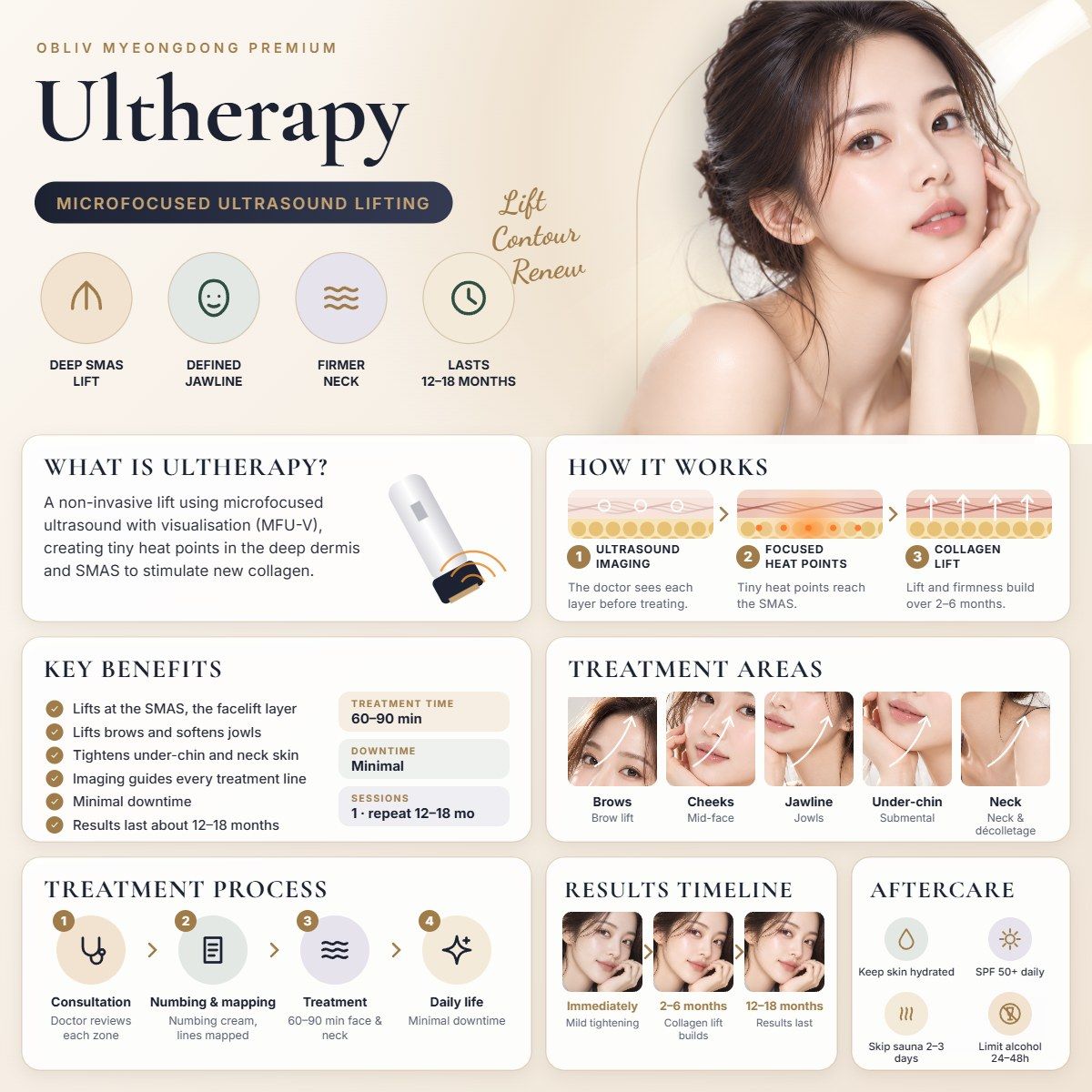
Ultherapy is a non-invasive lifting treatment that uses microfocused ultrasound with visualisation (MFU-V) to create tiny heat points in the deep dermis and the SMAS, stimulating new collagen. It is FDA-cleared to lift the eyebrow and lax tissue under the chin and on the neck, and to improve lines on the décolletage. At Obliv Clinic near Myeongdong and Jongno, Seoul, a doctor images each zone before treating; a full face and neck takes about 60–90 minutes, downtime is minimal, results build over 2–6 months and usually last around 12–18 months.
Key takeaways
- Ultherapy reaches the SMAS (about 4.5 mm deep), the same layer a surgical facelift tightens, which is why it gives more structural lift than surface lasers.
- The built-in ultrasound image lets the doctor see skin, fat, SMAS and bone before each line — the 'V' in MFU-V and a key safety feature.
- Ultherapy Prime is the latest platform; it keeps the same transducers and depths with an updated imaging screen and workflow.
- Expect deep, prickly aches along the bone during treatment and mild tenderness for days to a few weeks; there is usually no visible wound.
- Results are gradual and moderate. Heavy jowls or a very loose neck may still need surgery; a doctor will tell you honestly.
What is Ultherapy and how does MFU-V work?
Ultherapy, made by Merz Aesthetics, was the first energy-based device cleared by the US FDA to lift rather than simply tighten skin. It focuses ultrasound beams into tiny points of heat — around 60–70 °C — at precise depths beneath an intact skin surface. Each point creates a minute thermal coagulation zone; the body responds by contracting surrounding tissue and producing new collagen over the following months. In Korean clinics it is often called "울쎄라" (ulsera).
What makes Ultherapy distinct is visualisation. The transducer can show a live ultrasound image of the skin, fat, SMAS and bone beneath it. The doctor checks this view to confirm the transducer is properly coupled and that the planned depth is correct for the anatomy in that exact spot, avoiding bone and thin areas. This is why published reviews refer to the technology as MFU-V, microfocused ultrasound with visualisation.
Ultherapy Prime is the newest generation of the platform. It uses the same family of transducers and depths, with an updated high-resolution screen and workflow. For you as a patient, the treatment principle, comfort and expected results are very similar; what matters most is the doctor's mapping and the number and placement of lines.

Which layers Ultherapy treats: why the SMAS matters
Obliv's Skin Architecture method breaks sagging into layers. The SMAS (superficial musculo-aponeurotic system) is a fibrous sheet that connects facial muscles to the skin. When it relaxes with age, the cheeks, jowls and brow descend together. A surgical facelift repositions this layer; Ultherapy is one of very few non-invasive tools that can reach it without incisions.
Three standard depths are used. The 4.5 mm transducer targets the SMAS for lift; the 3.0 mm transducer works in the deep dermis for firmness; and the 1.5 mm transducer refines superficial crepiness. Narrow transducers allow careful work near the brow and in smaller areas. Your doctor chooses which depths to use in each zone based on the live image and on the thickness of your skin and fat, so two faces receive quite different plans.

Areas we treat with Ultherapy
Ultherapy is best known for the brow, lower face and neck. The FDA indications cover lifting the eyebrow, lifting lax tissue under the chin and on the neck, and improving lines and wrinkles on the décolletage; clinicians also use it on the cheeks and jawline as part of a full lower-face plan.
- Brow lift — a subtle lift of a low or heavy brow, which can make hooded upper eyelids look more open; pairs with Thermage Eye for crepey lids.
- Jawline and jowls — the most popular zone for international visitors; see sagging skin and jowls.
- Under-chin (submental) — tightens loose tissue for a cleaner jaw-neck angle.
- Neck — firms the upper neck and softens fine horizontal lines.
- Décolletage — improves fine lines on the upper chest.
Ask a doctor about Ultherapy
Send a photo and your travel dates on WhatsApp (+82-10-3086-4084). English replies, a personal plan and a written quote before you fly.
Ultherapy vs Thermage, HIFU and a surgical facelift
Ultherapy, Thermage and generic HIFU are often confused. Ultherapy and HIFU both use focused ultrasound; Ultherapy adds real-time imaging and a longer clinical evidence base, while many HIFU devices treat at fixed cartridge depths without a live view. Thermage uses radiofrequency to heat a broad volume of dermis for firmness rather than lift. A surgical facelift remains the most powerful option for advanced sagging. Our skin tightening overview compares every option side by side.
| Option | Energy and depth | Imaging | Strength | Typical pairing |
|---|---|---|---|---|
| Ultherapy / Ultherapy Prime | MFU-V at 1.5, 3.0, 4.5 mm | Yes, real-time view | Structural lift of brow, jaw, neck | Thermage for skin firmness |
| Other HIFU devices | Focused ultrasound at fixed cartridges | Usually no | Jawline definition, under-chin | RF or boosters |
| Thermage FLX | Monopolar RF, deep dermis volume | No (impedance sensing) | Overall firmness, crepey skin | Ultherapy for lift |
| ONDA lifting | Microwave, subcutaneous fat | No | Full cheeks, jowl fat | HIFU or RF |
| Surgical facelift | Incisions, SMAS repositioned | Not applicable | Largest, longest change | Energy devices for maintenance |
Who is a good candidate for Ultherapy?
Ultherapy suits adults, typically from their mid-thirties, with mild to moderate laxity and enough soft tissue for the energy to work on. A systematic review of microfocused ultrasound found it effective for mild to moderate facial laxity, with smaller benefit in people with a higher BMI. Very slim or already hollow faces need a careful plan, because lifting without addressing lost volume can look tired; in these cases we may combine lighter Ultherapy with a skin booster or volume support.
Your Ultherapy appointment step by step
Ultherapy is more uncomfortable than most surface treatments. Each line feels like a deep, prickly ache, strongest over bony areas such as the jawline and forehead and lighter over the cheeks. The sensation stops the moment the line is finished. Tell your doctor when a zone feels too intense; energy can be lowered or a narrower transducer used, which keeps you comfortable without throwing away the result.
- Before you fly: send front and side photos, your previous lifting dates and your travel plans on WhatsApp. We reply in English with a likely plan.
- Mark-Vu imaging and consultation: the doctor assesses laxity, fat and bone structure and agrees zones and line counts with you in writing.
- Comfort: numbing cream and cooling are applied; oral pain relief can be discussed if you are sensitive.
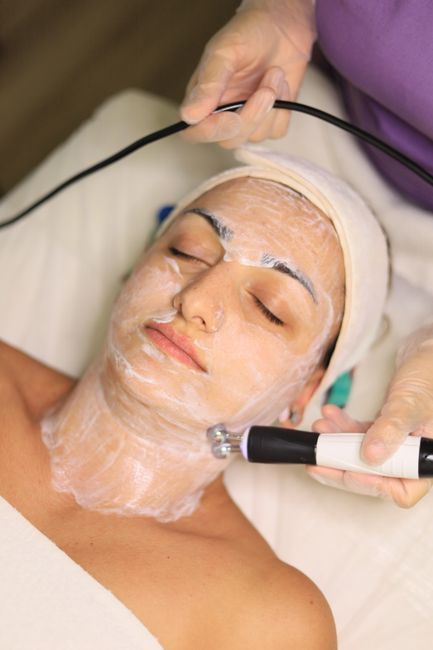
- Treatment: the face is marked into zones, ultrasound gel applied, and the doctor images each area before delivering lines at the chosen depths. A full face and neck usually takes 60–90 minutes.
- Aftercare: gel is cleaned away, sunscreen applied, and you receive written instructions and a WhatsApp contact for questions after you leave Seoul.
Results and recovery timeline
Some people notice a slight change on the day, but the lift Ultherapy is known for develops gradually as collagen rebuilds over two to six months. Take your own photos in the same light and angle before treatment and again at three and six months; because change is slow, side-by-side photos show it far better than the mirror.
Results soften over time because ageing continues, and many people plan maintenance every 12–18 months. A single treatment rarely 'wears off' abruptly; instead your face ages from a slightly improved starting point. Sun protection, not smoking and stable weight all help a result last.
Ultherapy for travellers: timing around flights and events
Ultherapy leaves no wound, so most visitors return to sightseeing the same day and fly home within a day or two. The main thing to plan for is tenderness: the jaw may feel sore when chewing for several days, and occasionally small bruises appear over bone. Our guide to Ultherapy around Myeongdong covers practical timing for short trips.
For a wedding or important photos, book three to six months ahead so the lift is well developed. If you only have a few weeks, a no-downtime refresher such as a booster or Botox gives a quicker visible change, and Ultherapy can follow later for longer-term structure.

- Ultherapy Around Myeongdong Seoul
- Tourist-Friendly Lifting Procedures in Seoul
- First Visit & What to Expect
Combining Ultherapy with Thermage, Botox and boosters
Because Ultherapy lifts deep and Thermage firms the dermis, the two are frequently combined on the same day in Korean clinics, often called an 'Ulthera-Thermage' combination. When they are, ultrasound usually comes first and radiofrequency second, with a doctor adjusting energy so the same zone is not over-heated. This layered approach is the core of our non-surgical facelift.
Botox pairs well with Ultherapy: relaxing the muscles that pull the brow down can enhance a brow lift, and relaxing the platysma can sharpen the jaw-neck line. Injectables are usually given after energy treatments. If you already have fillers or threads, tell your doctor the dates; several weeks' gap before ultrasound in the same area is usually recommended. See combination RF lifting treatments in Seoul for how these plans are sequenced.
Ultherapy price in Seoul: what affects cost
Ultherapy in Seoul is usually quoted by number of lines (sometimes called shots) and areas. More lines are not automatically better: the right number depends on face size, how many depths are used and how much laxity there is. A quote is only comparable to another if it states the device, the line count and the zones covered.
We give a written quote after consultation, record your line counts and depths in your Skin Library, and do not change the plan on the day without your agreement. See prices and payment for how international patients pay. Korea's cosmetic VAT refund for foreign visitors ended on 31 December 2025; details are in our tax refund update.
Risks, side effects and safety
Every medical aesthetic treatment carries some risk. These are the effects our doctors explain before you consent:
- Redness for up to about an hour and mild swelling for a day or two.
- Tenderness, a bruised feeling or soreness when chewing, which can last from days to a few weeks.
- Small bruises or welts, especially over bony areas of the jaw and neck.
- Temporary tingling, numbness or patchy sensitivity that usually resolves over weeks.
- Rarely, temporary weakness of a small facial nerve branch affecting the smile; doctors avoid nerve danger zones and adjust depth on the live image.
- Rarely, small burns or raised marks, or volume loss in very thin faces if over-treated.
Aftercare checklist
- Use a gentle cleanser, plain moisturiser and broad-spectrum sunscreen for the first week.
- Avoid saunas, jjimjilbang, hot yoga and intense exercise for 1–2 days.
- Pause retinoids, acids and scrubs for 3–5 days if the skin feels sensitive.
- Eat soft foods for a few days if your jaw is tender; avoid firm facial massage for 1–2 weeks.
- Paracetamol (acetaminophen) is usually enough for soreness; check with us before taking anti-inflammatories.
- Message us on WhatsApp with a photo if you notice raised welts, lasting numbness or any change in your smile.
Frequently asked questions
How long does Ultherapy last?
Most people see results for about 12–18 months, sometimes longer. The skin keeps ageing, so maintenance is usually planned once a year or so.
When will I see Ultherapy results?
There may be a slight change on the day, but most lift develops over 2–3 months and peaks at around 3–6 months as new collagen forms.
Does Ultherapy hurt?
It can be uncomfortable, especially over bone. Numbing cream, cooling and adjusting energy or transducer depth help, and the sensation stops as soon as each line is finished.
What is the difference between Ultherapy and Ultherapy Prime?
Ultherapy Prime is the latest platform from the same maker. It uses the same type of transducers and depths with an updated imaging screen and workflow; the mechanism and expected results are similar.
Is Ultherapy the same as HIFU?
Both use focused ultrasound. Ultherapy adds real-time imaging (MFU-V) so the doctor can see the layers before treating, and it has a long clinical evidence base. See our HIFU lifting page.
Ultherapy or Thermage: which should I choose?
Ultherapy lifts deeper at the SMAS; Thermage firms the dermis. For jowls and brow Ultherapy is usually the base, while Thermage adds skin quality. Many people combine both.
Can I fly after Ultherapy?
Yes. There is no wound, so flying a day or two later is generally fine. Expect some tenderness along the jaw and pack paracetamol if you are sensitive.
Is Ultherapy safe for Asian skin?
Ultrasound bypasses the skin surface, so the risk of pigmentation is low for all skin types. Doctors still adjust depths and energy for thinner skin and smaller faces.
Who should not have Ultherapy?
People with open wounds or infection in the area, those who are pregnant, and very slim faces where lift may look hollow. Recent fillers, threads and implants should be discussed first.
Do you offer Ultherapy consultations in English near Myeongdong?
Yes. Consultations are available in English, and you can message us on WhatsApp at +82-10-3086-4084 before you travel.
Related treatments and guides
From the Obliv Skin Journal
- Ultherapy Around Myeongdong Seoul
- Combination RF Lifting Treatments in Seoul
- Thermage Before Traveling Home
- Jawline Tightening Without Surgery
- Tourist-Friendly Lifting Procedures in Seoul
Ask a doctor about Ultherapy
Send a photo and your travel dates on WhatsApp (+82-10-3086-4084). English replies, a personal plan and a written quote before you fly.
Our five physicians plan every treatment by skin layer using the Obliv Skin Architecture method. Last reviewed 2026-10-27. This page is general information, not a diagnosis; your plan is set after an in-person consultation.
Sources and further reading
Explore Botox and fillers by area
Each area has its own anatomy, doses and safety rules. Choose an area for a doctor-reviewed guide with an infographic, typical doses, recovery and FAQs.
Botox by area · overview
- Jaw Botox
- Forehead
- Frown lines
- Crow’s feet
- Bunny lines
- Under-eye
- Brow lift
- Gummy smile
- Lip flip
- Mouth corners
- Chin
- Neck bands
- Skin Botox
- Baby Botox
- Preventative
- Botox for men
- Teeth grinding
- Shoulder
- Calf
- Underarm sweating
Dermal fillers by area · overview
- Nose
- Lips
- Chin
- Jawline
- Cheeks
- Under-eye
- Aegyo-sal
- Temples
- Forehead
- Sunken eyelids
- Smile lines
- Marionette lines
- Lip corners
- Pre-jowl
- Frown lines
- Neck lines
- Hands
- CaHA filler
- Full-face plan
- Filler dissolving
Every plan is made by one of our doctors after an in-person examination.