

Injectables · Liquid rhinoplasty
Non-Surgical Nose Lift in Myeongdong & Jongno, Seoul

Injectables · Liquid rhinoplasty

Non-Surgical Nose Lift in Myeongdong & Jongno, Seoul

A non-surgical nose lift uses small amounts of hyaluronic acid filler to straighten, raise or refine the nose without surgery. Because the nose is the highest-risk area for filler, at Obliv Clinic Seoul Origin it is planned and performed only by doctors, with vascular safety at the centre of every step.

Natural side profile after a non-surgical nose lift at Obliv Clinic near Myeongdong, Seoul

Quick answer

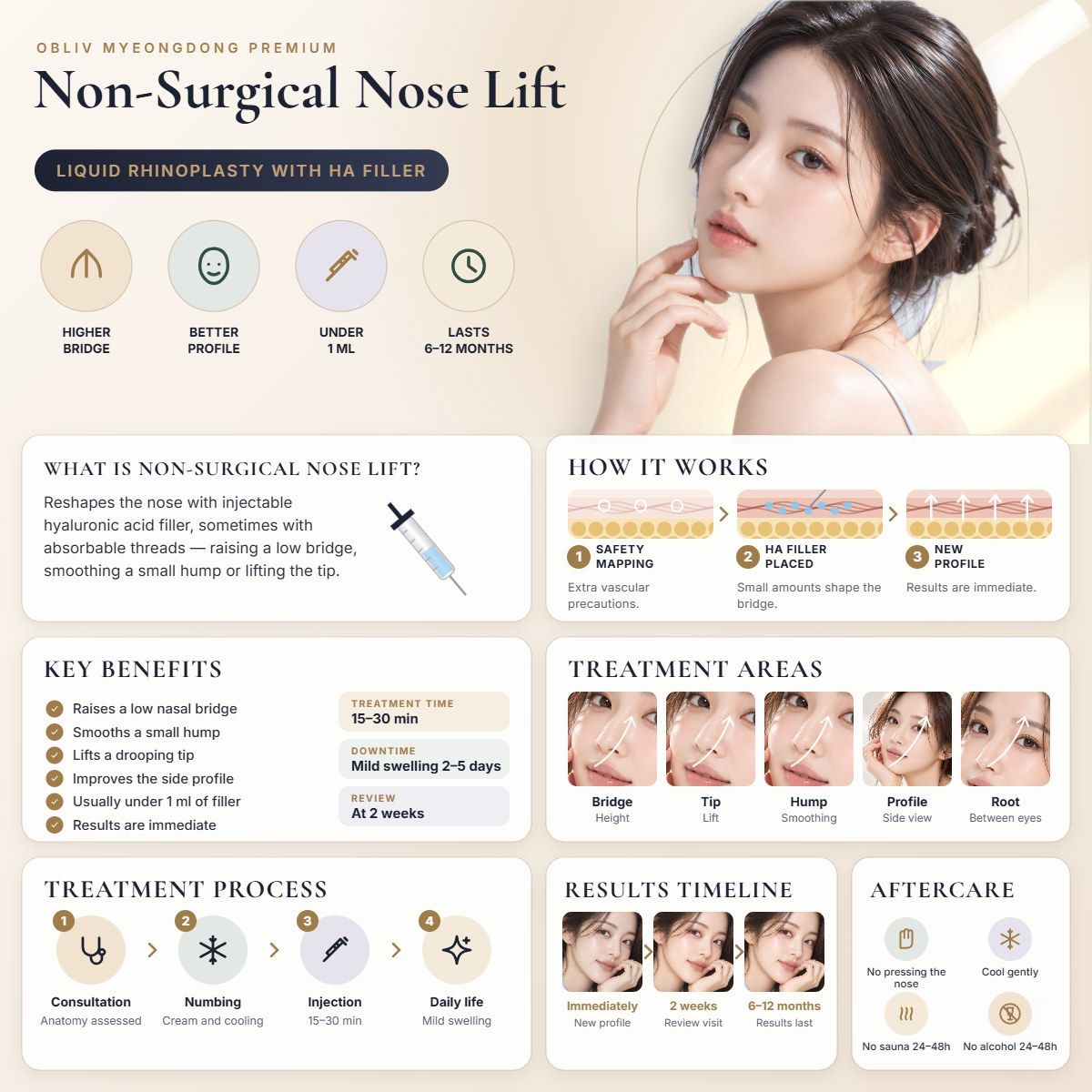
A non-surgical nose lift, or liquid rhinoplasty, reshapes the nose with injectable hyaluronic acid (HA) filler, sometimes combined with absorbable threads. It can raise a low bridge, smooth a small hump, lift a drooping tip and improve the side profile in about 15–30 minutes, typically using under 1 ml. Results are immediate and usually last about 6–12 months. It cannot make a nose smaller or improve breathing. At Obliv near Myeongdong and Jongno, Seoul, doctors treat the nose with extra vascular precautions.

Time15–30 min plus numbing
DowntimeMild swelling 2–5 days
Sessions1 session; review at 2 weeks
LastsAbout 6–12 months

Key takeaways

  • Liquid rhinoplasty adds volume: it can raise and straighten, but it cannot reduce size, narrow the nostrils or fix breathing problems.
  • The nose is the area most often linked to serious filler complications such as skin necrosis and vision loss, so injector skill and anatomy knowledge matter more here than anywhere else.
  • We use only dissolvable HA filler in the nose, in small volumes, and keep hyaluronidase ready in the room.
  • Expect immediate shape, mild swelling for a few days and a settled result at about 2 weeks; most people need a top-up within a year.
  • Previous nose surgery, implants or permanent filler increase risk and may make liquid rhinoplasty unsuitable.

What is a non-surgical nose lift?

A non-surgical nose lift, also called liquid rhinoplasty, non-surgical rhinoplasty or, in Korea, nose filler (코필러), uses injectable hyaluronic acid gel to change the visible shape of the nose. By adding volume in precise places, a doctor can raise the bridge, create a straighter line from forehead to tip, smooth over a small bump, and give a drooping tip a little more lift. The change is immediate and the procedure usually takes well under an hour including numbing.

It is important to understand what liquid rhinoplasty is not. Because it works by adding volume, it cannot make a nose smaller, narrow wide nostrils, shorten a long nose or correct breathing problems. Professional bodies such as the American Society of Plastic Surgeons and The Aesthetic Society describe it as best for minor refinements, and surgical rhinoplasty remains the right option for reduction or structural change.

Results are temporary. Clinical sources commonly describe a duration of roughly six months to a year, depending on the product and your anatomy. For many visitors that is an advantage: it allows a reversible preview of a higher bridge or refined profile, and it can be dissolved if you do not like it.

Non-Surgical Nose Lift at a glance Treatment time: 15–30 min plus numbing; Comfort / numbing: Numbing cream; lidocaine in gel; Downtime: Mild swelling 2–5 days; Typical sessions: 1 session; review at 2 weeks; Results appear: Immediate; settled ~2 weeks; Results last: About 6–12 months AT A GLANCE · OBLIV MYEONGDONG Non-Surgical Nose Lift TREATMENT TIME 15–30 min plus numbing COMFORT / NUMBING Numbing cream; lidocaine in gel DOWNTIME Mild swelling 2–5 days TYPICAL SESSIONS 1 session; review at 2 weeks RESULTS APPEAR Immediate; settled ~2 weeks RESULTS LAST About 6–12 months
Non-Surgical Nose Lift at a glance at Obliv Myeongdong. Ranges are typical; your doctor confirms them for your skin.

Why the nose needs extra care: vascular anatomy

The nose has a rich blood supply from several connected arteries, including the dorsal nasal artery along the bridge and the lateral nasal and columellar branches near the tip. Some of these vessels connect, through the angular artery and the ophthalmic system, to the arteries that feed the eye. If filler enters or compresses one of these vessels, blood flow can be cut off to the skin of the nose and, in rare cases, travel backward toward the eye.

This is why the nose matters so much. A 2024 review of more than a century of published cases of blindness after filler found the nose to be the single most common injection site, involved in roughly four in ten reported cases. The absolute risk per treatment is low, but the consequences can be permanent, and the risk is higher after previous surgical rhinoplasty, because scar tissue alters and fixes the course of vessels.

For these reasons, the US FDA lists the nose among areas where filler use carries particular safety concerns, and specialist societies recommend that liquid rhinoplasty be performed only by experienced medical injectors who know nasal anatomy in detail. At Obliv, nose filler is a doctor-only procedure; we explain the risks in plain language before you decide, and we decline treatment when the risk is not justified.

After nose filler, contact us immediately (WhatsApp +82-10-3086-4084) if you notice severe or increasing pain, white, grey or dusky patches on the nose or cheek, blisters or a net-like rash, or any blurred or lost vision. Vision changes are an emergency: call 119 in Korea.
Which skin layer Non-Surgical Nose Lift targets muscle: Filler is placed deep, beneath the nasal muscle layer, directly on bone and cartilage where vessels are fewer.; fat: Superficial fat holds the main nasal arteries, so this layer is avoided during injection. SKIN ARCHITECTURE · TARGET LAYER MAP Epidermis 0.05–0.1 mm Dermis (collagen & elastin) 1–3 mm Subcutaneous fat 3–4.5 mm+ Superficial fat holds the main nasal arteries, so this layer is avoided during injection. SMAS (fibromuscular layer) ≈ 4.5 mm Muscle deeper Filler is placed deep, beneath the nasal muscle layer, directly on bone and cartilage where vessels are fewer. Schematic, not to scale. Depths vary by face area, age and skin type; your doctor sets them after examination.
Skin Architecture view: the layers Non-Surgical Nose Lift works on.

How Obliv performs liquid rhinoplasty safely

The procedure begins with assessment, not injection. Your doctor studies your nose from the front, side and below, together with the forehead, lips and chin, because a natural nose is defined by its relationship to the rest of the face. Under our Skin Architecture approach, we also check skin thickness over the tip, previous procedures and whether a small amount of chin support would balance the profile more effectively than adding to the nose.

We use only dissolvable, cohesive HA filler in the nose, in small volumes — commonly well under 1 ml for the whole treatment. Injections stay close to the midline and are placed deep, on the bone and cartilage, where large vessels are fewer. Depending on anatomy the doctor may use a blunt cannula, injects very slowly in tiny increments, and watches the skin colour continuously for any blanching. If anything looks wrong, injection stops at once.

Hyaluronidase and an occlusion protocol, based on published management guidelines, are ready in the treatment room before we begin. All product names, lot numbers and volumes are entered into your Skin Library record, which you can take home; this matters if you later see a surgeon or another injector.
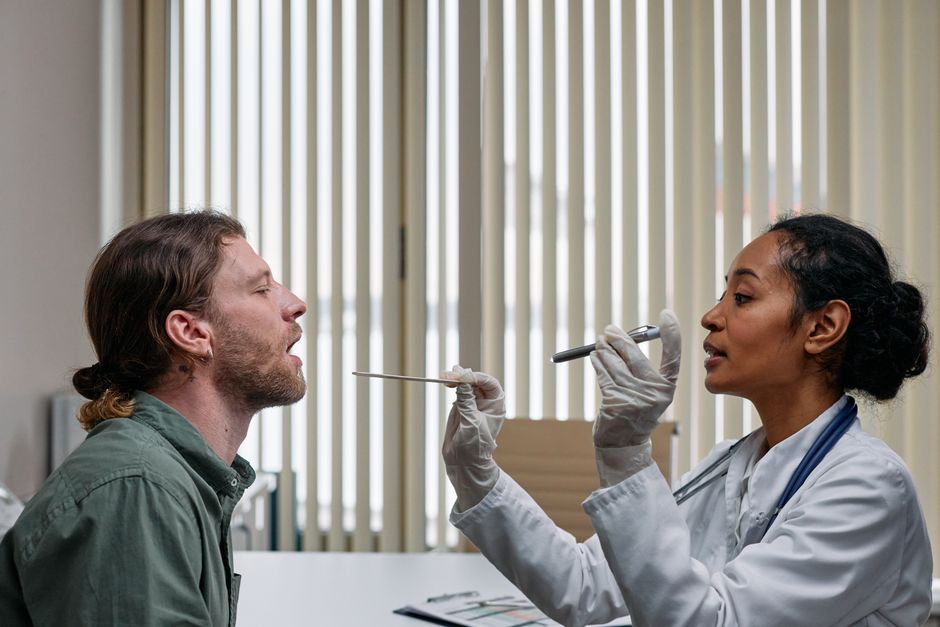
Doctor's tip: a nose often looks larger because the chin is short. Many profile concerns are better solved with 1–2 ml of chin filler and only a little nose filler, rather than more product in the nose.
Doctor assessing nasal profile before liquid rhinoplasty in Seoul
Profile, skin thickness and vascular risk are assessed before any injection.

Ask a doctor about Non-Surgical Nose Lift

Send a photo and your travel dates on WhatsApp (+82-10-3086-4084). English replies, a personal plan and a written quote before you fly.

Filler, threads and surgery compared

In Korea, nose treatments are sometimes combined with absorbable PDO threads placed along the columella or bridge to add tip support. Threads can help selected noses, but they add their own risks, such as infection or a thread becoming visible, and they are not suitable for everyone. Surgical rhinoplasty is permanent and can reduce, narrow and correct function; it is a different category of treatment requiring a plastic surgeon. The table shows how we explain these options.

Option What it does Best for Downtime Typical duration
HA filler (liquid rhinoplasty) Adds height and smooths contour Low bridge, small hump, tip lift 2–5 days swelling About 6–12 months
Filler + absorbable threads Threads add tip and columella support Selected noses needing tip support About 1 week About 6–12 months
Surgical rhinoplasty Reshapes bone and cartilage Reduction, narrowing, breathing 1–2 weeks+; months to settle Permanent
Chin filler Balances the profile from below Recessed chin making the nose look large 2–7 days About 12 months+
Botox for nose Relaxes a tip-depressing muscle or bunny lines Tip drop when smiling None 3–4 months

Who is a good candidate?

The best candidates want a subtle change: a slightly higher bridge, a smoother line or a little more tip lift. They have no breathing problems, no previous nose surgery or permanent fillers, and realistic expectations about what added volume can do. Many East Asian visitors ask for a higher, straighter bridge, while many Western visitors ask to camouflage a small hump; both can suit liquid rhinoplasty in moderation.

If you want a smaller nose, a narrower tip or improved breathing, our doctors will tell you honestly that surgery is the right path and that filler can make later surgery more complex. We also advise against repeated, large-volume nose filler, which can widen the bridge over time. For a wider view of balancing the face without surgery, see facial balancing without surgery.

Who Non-Surgical Nose Lift suits, and who should consider another option Good fit: A low or flat nasal bridge you would like slightly higher; A small dorsal hump you want camouflaged by smoothing above and below; A slightly drooping or under-projected tip; Minor asymmetry or a mild curve along the bridge; Wanting a preview before deciding on surgical rhinoplasty. Not ideal: Previous surgical rhinoplasty or implant (higher vascular risk); Wanting a smaller, narrower or shorter nose; Breathing problems or a deviated septum; Permanent or unknown filler already in the nose; Thick, tight skin over the tip, or pregnancy and breastfeeding. ✓ Usually a good fit ✕ Discuss other options first A low or flat nasal bridge you would like slightly higher A small dorsal hump you want camouflaged by smoothing above and below A slightly drooping or under-projected tip Minor asymmetry or a mild curve along the bridge Wanting a preview before deciding on surgical rhinoplasty Previous surgical rhinoplasty or implant (higher vascular risk) Wanting a smaller, narrower or shorter nose Breathing problems or a deviated septum Permanent or unknown filler already in the nose Thick, tight skin over the tip, or pregnancy and breastfeeding
Is Non-Surgical Nose Lift right for you? A doctor confirms suitability at consultation.

Your nose filler appointment step by step

We ask nose filler patients to stay in the clinic briefly after treatment so the doctor can check skin colour and comfort. If you are combining treatments, we usually avoid strong device energy over the nose on the same day. Our first visit guide covers what to bring.

  1. Before you fly: send front, side and base-view photos and your history of any nose surgery, threads or filler on WhatsApp.
  2. Mark-Vu imaging and profile photos: about 10 minutes; make-up is removed.
  3. Doctor consultation: profile analysis, honest discussion of risks and alternatives, and a written plan.
  4. Numbing and injection: numbing cream, then 15–30 minutes of slow, deep injection with continuous skin checks.
  5. Observation and aftercare: we observe you before you leave, give written aftercare and a direct WhatsApp contact.
Your visit to Obliv Myeongdong in five steps: WhatsApp – Send photos, concerns and travel dates in English; Mark-Vu analysis – Imaging of pigment, redness, pores and texture; Doctor consult – Layer-by-layer plan, dose and written quote; Treatment – Private room, numbing and comfort checks; Aftercare – Written care plan and WhatsApp follow-up
How a visit to Obliv Clinic Seoul Origin works, from first WhatsApp message to aftercare.

Results and recovery timeline

The new shape is visible immediately. Mild swelling and tenderness usually last a few days and are most noticeable at the tip. Bruising is less common than in the lips but possible. By the end of the first week most people look natural, and at two weeks the result has settled enough to judge.

Nose filler typically lasts about six to twelve months; the bridge tends to hold longer than the more mobile tip. Before any repeat session, we reassess rather than simply adding more, to avoid the gradual widening that can follow repeated layers of gel.

Non-Surgical Nose Lift recovery and results timeline Day 0: New profile visible straight away. Mild redness and tenderness; avoid pressure on the nose.; Day 1–3: Some swelling, especially at the tip. No glasses resting on the bridge if possible.; Day 4–7: Swelling settles and the shape looks natural in photos.; Day 14: Review with your doctor; small refinements only if needed.; Month 6–9: Tip filler usually softens first; bridge support often remains.; Month 9–12: Most of the effect has faded; reassess before any repeat treatment. RECOVERY & RESULTS TIMELINE 1 Day 0 New profile visible straight away. Mild redness and tenderness; avoid pressure on the nose. 2 Day 1–3 Some swelling, especially at the tip. No glasses resting on the bridge if possible. 3 Day 4–7 Swelling settles and the shape looks natural in photos. 4 Day 14 Review with your doctor; small refinements only if needed. 5 Month 6–9 Tip filler usually softens first; bridge support often remains. 6 Month 9–12 Most of the effect has faded; reassess before any repeat treatment.
What to expect after Non-Surgical Nose Lift, day by day.

Nose filler for travellers: timing and aftercare abroad

Because nose filler complications, while rare, usually appear within minutes to hours, we recommend booking it early in your stay rather than on your last day, and staying in Seoul for at least 24–48 hours afterward. Avoid resting heavy glasses on the bridge for about a week, and do not sleep face-down. Flying after the first couple of days is generally fine.

You leave with an English record of the product, volume and injection points, and direct WhatsApp contact to the clinic. If you are combining your trip with other treatments, our foreigner-friendly clinic guide explains how we schedule multi-treatment visits.
Visitor relaxing in central Seoul after a nose filler appointment
We recommend staying in Seoul for 24–48 hours after nose filler for review.

Nose filler price in Seoul: what affects cost

Cost depends on the product, the volume needed, whether threads are added and whether a review is included. Because the nose is a high-skill area, the injector's experience and the safety measures in place matter more than the price per syringe.

You receive a written quote after consultation. See prices and payment for how payment works; Korea's cosmetic VAT refund for foreign visitors ended on 31 December 2025, as explained in our tax refund update.

Risks, side effects and safety

Every medical aesthetic treatment carries some risk. These are the effects our doctors explain before you consent:

  • Swelling, redness and tenderness, usually settling within a few days.
  • Bruising, less common than in lips but possible, fading within 1–2 weeks.
  • Unevenness or a widened bridge, correctable with hyaluronidase.
  • Infection or delayed inflammatory nodules, uncommon and treatable.
  • Vascular occlusion causing skin damage on the nose — rare but serious; treated urgently with hyaluronidase.
  • Vision loss — very rare but more often linked to the nose than any other area; the main reason we treat conservatively.
Seek medical help promptly if you notice severe or worsening pain, skin turning white, grey or dusky, blisters, spreading redness, fever, or any change in vision. Message the clinic on WhatsApp, and in an emergency in Korea call 119.

Aftercare checklist

  1. Do not press, massage or squeeze the nose for 1 week.
  2. Avoid heavy glasses resting on the bridge for about 7 days; tape them up or use contacts.
  3. Sleep on your back with your head slightly raised for 2–3 nights.
  4. Skip saunas, jjimjilbang and intense exercise for 48 hours.
  5. Avoid alcohol for 24 hours.
  6. Contact us immediately for pain, skin colour change or any vision change.

Frequently asked questions

How long does a non-surgical nose lift last?

Usually about 6–12 months with hyaluronic acid filler. The bridge often holds longer than the tip. Results vary with product, volume and anatomy.

Can nose filler make my nose smaller?

No. Filler adds volume, so it can raise, straighten and smooth but cannot reduce size, narrow nostrils or shorten the nose. Surgery is needed for reduction.

Is nose filler safe?

Serious complications are rare, but the nose is the area most often linked to filler-related skin necrosis and vision loss. Safety depends on an experienced doctor, deep midline placement, small volumes, dissolvable HA and immediate access to hyaluronidase.

Can I have nose filler after a rhinoplasty?

Sometimes, but previous surgery increases vascular risk because scar tissue changes the vessels. Your doctor will assess carefully and may advise against it or recommend a surgical revision consultation.

What are threads in a nose lift?

Absorbable PDO threads can be placed to add tip support in selected noses, often with filler. They carry their own risks, such as infection or visibility, and are not suitable for everyone.

Does nose filler hurt?

Numbing cream and lidocaine in the gel keep it comfortable. Most people feel pressure and brief stings; the tip is the most sensitive part.

Can nose filler be dissolved?

Yes, hyaluronic acid filler can be dissolved with hyaluronidase if you dislike the result or, urgently, if a vascular complication occurs.

Can I fly after nose filler?

We recommend staying in Seoul for at least 24–48 hours so we can review you. After that, flying is generally fine.

Will nose filler make later surgery harder?

Repeated or large-volume filler can complicate later surgery. Surgeons generally advise limiting liquid rhinoplasty if you are planning a surgical rhinoplasty in the future.

Do you speak English for nose filler consultations?

Yes. Consultations are available in English; send your photos and history to +82-10-3086-4084 on WhatsApp before you travel.

From the Obliv Skin Journal

Ask a doctor about Non-Surgical Nose Lift

Send a photo and your travel dates on WhatsApp (+82-10-3086-4084). English replies, a personal plan and a written quote before you fly.

Explore Botox and fillers by area

Each area has its own anatomy, doses and safety rules. Choose an area for a doctor-reviewed guide with an infographic, typical doses, recovery and FAQs.

Botox by area · overview

Dermal fillers by area · overview

Every plan is made by one of our doctors after an in-person examination.