Facial Harmony Consultation
Facial Harmony Consultation in Seoul: Complete Guide
A facial harmony consultation is an assessment of how different facial features work together in terms of proportion, balance, symmetry, and overall appearance. Rather than focusing on only one feature, the consultation considers the face as a whole and may help identify which areas contribute to a balanced or less-balanced appearance.
In Seoul, facial harmony consultations can be offered through aesthetic clinics, dermatology clinics, plastic surgery practices, or beauty and image-consulting studios. The scope varies: a medical consultation may assess bone, muscle, fat, skin, and facial proportions, while a beauty consultation may focus more on face shape, personal color, makeup, hairstyles, and styling.
What Is a Facial Harmony Consultation?
A facial harmony consultation looks at the relationship between individual facial features rather than treating each feature separately.
Depending on the provider, an assessment may consider:
- Forehead and temple proportions
- Eyebrow and eye position
- Nose-to-face proportions
- Cheek volume and contour
- Lip shape and position
- Chin projection
- Jawline definition
- Facial width and length
- Left-to-right facial symmetry
- Skin condition and texture
- Overall facial balance
The concept of facial harmony is individualized. There is no single facial proportion that is appropriate for everyone, because bone structure, ethnicity, age, expression, and personal preferences influence how facial balance is perceived.
What Happens During the Consultation?
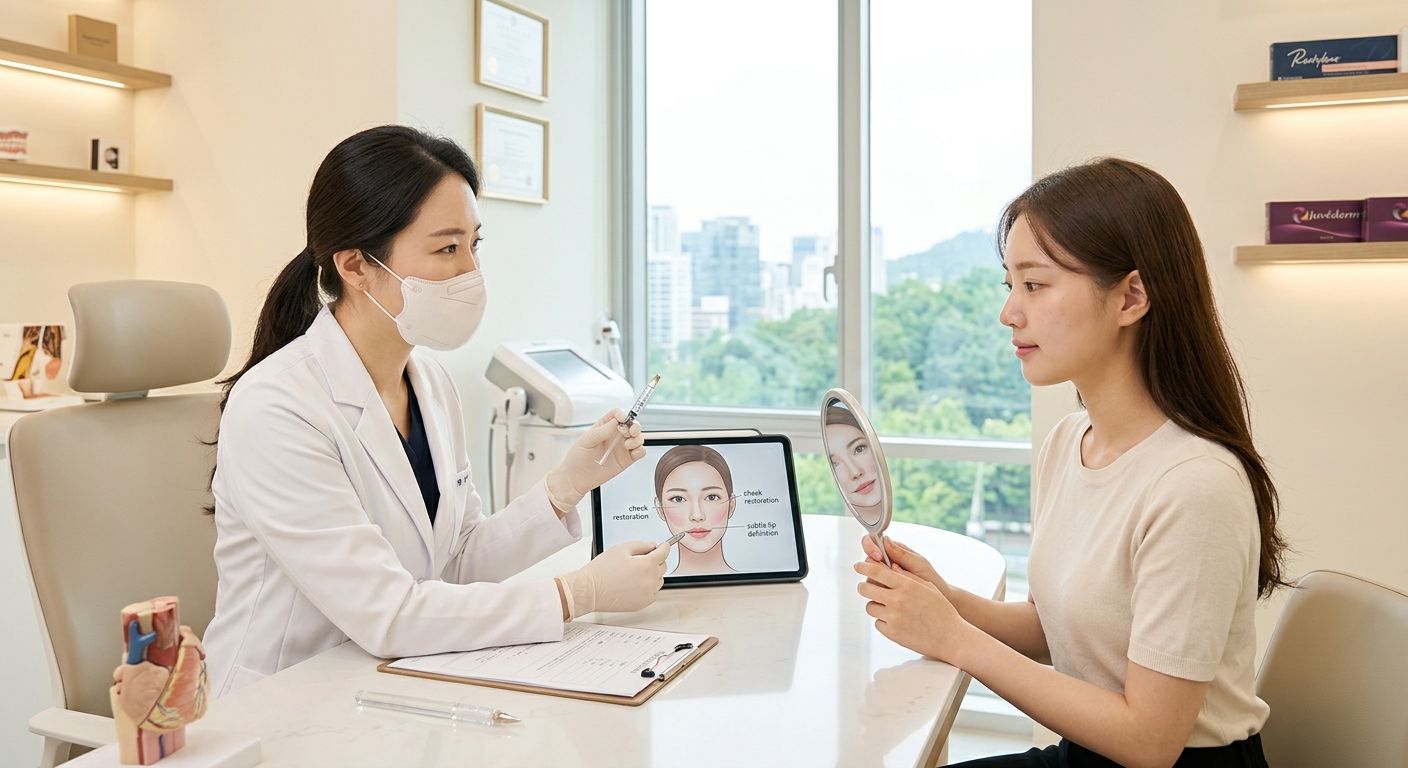
A medical facial harmony consultation generally begins with a discussion of the patient's concerns and aesthetic goals.
Facial Proportion Assessment
The provider may examine the face from several angles, including the front, three-quarter, and profile views. This can help identify differences in facial width, projection, contour, or symmetry.
Some Seoul aesthetic clinics describe assessments that consider facial structure together with soft tissues such as muscle, fat, and skin.
Facial Symmetry
Small differences between the two sides of the face are normal. The goal of an assessment is not necessarily to create perfect mathematical symmetry.
Instead, the consultation may determine whether an asymmetry is visually significant and whether an aesthetic treatment could realistically alter it.
Skin Assessment
If the consultation takes place at a dermatology or aesthetic clinic, the skin may also be assessed for concerns such as pigmentation, pores, wrinkles, elasticity, or texture.
Some clinics use digital or device-based skin analysis as part of their consultation process.
Facial Harmony vs. Personal Color Analysis
These two types of consultation are related to appearance but have different purposes.
Facial Harmony Consultation
A facial harmony assessment primarily examines:
- Facial proportions
- Contours
- Symmetry
- Feature relationships
- Skin and soft-tissue considerations
- Possible aesthetic treatment options
It is particularly relevant when someone is considering a medical or aesthetic procedure.
Personal Color and Image Consultation
A personal color consultation focuses more on colors and styling. Depending on the studio, it may include personal color analysis, face shape, eyebrow design, suitable hairstyles, makeup colors, and foundation matching.
Therefore, someone looking for advice about makeup, clothing, or hair may benefit from an image consultation, while someone considering an aesthetic procedure may need a medical facial assessment.
What Treatments May Be Discussed?
A facial harmony consultation does not automatically mean that treatment is required.
If a medical provider identifies an aesthetic concern, possible options depend on the underlying anatomy and the patient's goals.
Botox
Botulinum toxin may be discussed when muscle activity contributes to concerns such as a prominent masseter or certain expression-related lines.
It does not change the underlying facial bones.
Dermal Fillers
Fillers may sometimes be considered to modify selected areas of facial volume or projection, such as the chin or cheeks.
However, adding volume is not appropriate for everyone. Excessive or poorly placed filler can affect facial proportions rather than improve them.
Skin Tightening
Energy-based treatments may be considered when skin laxity contributes to a less-defined facial contour.
The appropriate device and treatment intensity depend on individual skin and tissue characteristics.
Contouring Procedures
Depending on the concern, a provider may discuss options for facial fullness, jawline definition, or other contour-related issues.
A consultation is important because a face that appears wide may be influenced by bone structure, muscle, fat, skin laxity, or several factors at once.
Why Individual Assessment Matters
A common mistake is choosing a treatment based only on a desired facial shape.
For example, two people may both describe their face as “round,” but one may have fuller soft tissue while another has a shorter lower face or a different skeletal structure.
Likewise, reducing facial volume may not always improve harmony. In some cases, maintaining or strategically adding volume may create a more balanced appearance.
This is why facial assessment should precede treatment selection rather than assuming that one procedure is suitable for everyone. A Seoul aesthetic clinic's published explanation of facial harmony similarly emphasizes the relationship between multiple facial structures rather than focusing on one isolated feature.
Facial Harmony Consultation for International Patients
International patients may find facial consultations useful before deciding whether to undergo treatment in Seoul.
Before booking, check whether the provider offers:
- English or another language you require
- Medical consultation directly with a qualified professional
- Clear explanation of proposed procedures
- Information about expected downtime
- Details about possible side effects
- Written treatment information
- Follow-up arrangements after returning home
Some Seoul clinics specifically advertise multilingual consultation and international-patient support.
If you have previously received Botox, fillers, thread lifting, facial surgery, or other aesthetic procedures, provide the clinician with as much relevant treatment history as possible.
How to Prepare for a Facial Harmony Consultation
Preparation can make the consultation more productive.
Bring Your Main Concerns
Instead of simply saying that you want a “more beautiful” or “smaller” face, identify the features you would like to understand.
For example:
- Jawline appears too wide
- Chin looks recessed
- Face appears longer from the side
- One side looks different from the other
- Cheeks appear overly full
- Skin laxity affects the jawline
Bring Treatment History
Tell the provider about previous cosmetic procedures, including approximately when they were performed if you know.
This information can be important when discussing additional treatments.
Bring Reference Photos Carefully
Reference photographs can communicate your aesthetic preferences, but they should not be treated as guarantees of an achievable result. Facial anatomy differs significantly between individuals.
What Are the Limitations?
Facial harmony is partly subjective. A computer-generated measurement or facial score cannot determine exactly what will look best for every individual.
Digital analysis can support assessment, but it does not replace professional clinical judgment when medical treatment is being considered.
Results also vary according to anatomy, treatment choice, provider technique, and individual response.
A consultation should therefore explain both what may be changed and what cannot realistically be changed without more invasive treatment.
Frequently Asked Questions
What is the purpose of a facial harmony consultation?
The purpose is to evaluate facial proportions, symmetry, contours, and the relationship between different features so that aesthetic concerns can be understood more comprehensively.
Is facial harmony consultation the same as plastic surgery consultation?
No. A facial harmony consultation may be part of a plastic surgery consultation, but it can also be offered by dermatology or aesthetic clinics and may not involve surgery.
Can a facial harmony consultation recommend non-surgical treatments?
Yes. Depending on the provider and assessment, options such as Botox, fillers, skin tightening, or other non-surgical procedures may be discussed.
Can facial harmony analysis tell me which treatment I need?
It can help identify relevant aesthetic concerns, but treatment suitability should be determined through an individualized professional assessment rather than a facial-analysis result alone.
Is facial harmony the same for every person?
No. Facial harmony is influenced by individual anatomy, proportions, expression, cultural and personal preferences, and other factors. There is no universal facial template.
Can international visitors have a facial harmony consultation in Seoul?
Yes. Some Seoul clinics and beauty studios provide services specifically for international visitors, including English or multilingual consultation. The exact scope and language support should be confirmed before booking.
Conclusion
A facial harmony consultation in Seoul can provide a broader understanding of facial proportions, symmetry, contours, skin, and the relationship between different facial features. It can be particularly useful for people who are considering aesthetic treatment but are unsure which feature or treatment should be addressed first.
The most useful consultation is not necessarily the one that recommends the most procedures. Instead, it should help you understand your facial structure, realistic treatment possibilities, limitations, potential risks, and whether any intervention is appropriate for your goals.
For international patients, confirming the provider's qualifications, consultation language, treatment plan, recovery expectations, and follow-up arrangements is an important part of planning care in Seoul.