

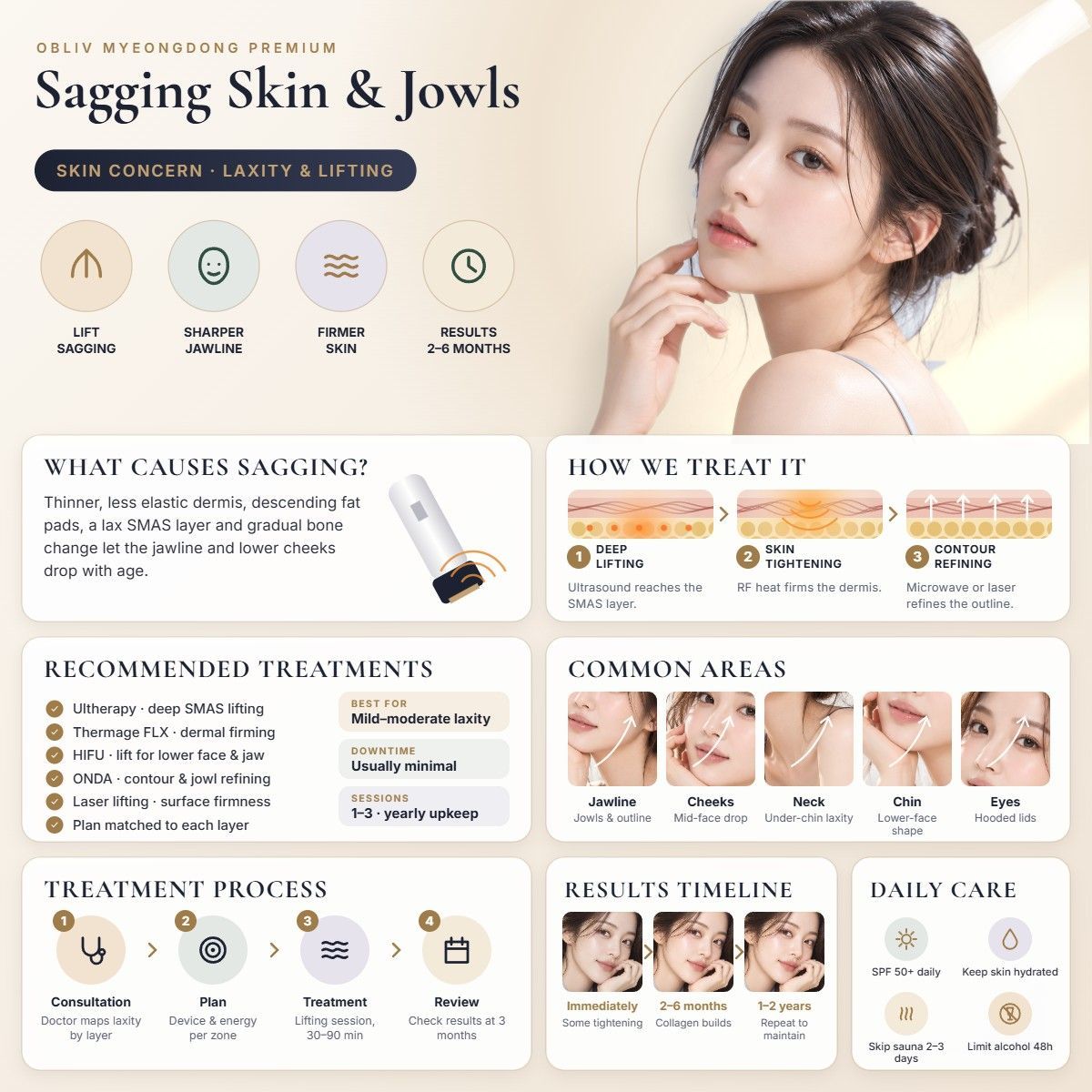
Skin concerns · Laxity & lower-face contour

Sagging Skin & Jowls: Causes and Treatment in Myeongdong & Jongno, Seoul

Jowls rarely come from one cause. At Obliv Clinic Seoul Origin a doctor works out whether skin, fat, the SMAS layer or lost support is behind your lower-face sagging, then matches lifting energy and depth to that layer.

Woman checking her jawline during a sagging skin consultation at Obliv Clinic near Myeongdong, Seoul

Quick answer

Sagging skin and jowls are the loosening and downward shift of tissue along the jawline and lower cheeks, caused by a mix of thinner, less elastic dermis, deflating and descending fat pads, a lax SMAS layer, weaker retaining ligaments and gradual bone change. Mild to moderate laxity often improves with non-surgical lifting such as microfocused ultrasound (MFU-V, Ultherapy), monopolar RF (Thermage) or microwave contouring (ONDA), usually seen over 2–6 months. At Obliv near Myeongdong and Jongno, Seoul, a doctor first identifies which layer sags, then plans treatment for it.

TimeAssessment about 30–45 min
DowntimeUsually none to mild swelling
SessionsOften 1 lifting session a year
LastsAbout 1 year, varies by layer

Key takeaways

  • Jowls are a layered problem: loose skin, heavy or slipping fat, a lax SMAS and lost bony support can all contribute, and each needs a different tool.
  • Energy-based lifting such as Ultherapy and Thermage gives modest, gradual tightening that builds over roughly 2–6 months, not an instant facelift.
  • Mild to moderate laxity responds best; very heavy jowls, a lot of loose neck skin or a high body weight often do better with surgery, and we will say so.
  • Many faces need two steps: tighten the deeper layers, then restore lost support with collagen stimulators or carefully placed filler instead of filling the jowl itself.
  • Daily sunscreen, not smoking and steady weight are the most reliable ways to slow future sagging between treatments.

What causes sagging skin and jowls?

Jowls are the soft fullness that forms along the jawline, below the mouth corners, when tissue that once sat higher on the cheek gradually moves down and forward. Most people first notice them in their late thirties or forties, often in a photograph or a video call rather than the mirror. They are not a disease, but they change the outline of the lower face more than almost any wrinkle, which is why they are one of the most common reasons international visitors book a lifting consultation in Seoul.

Facial ageing research describes several processes working together. The dermis loses collagen and elastic fibres, especially after years of sun exposure, so skin recoils less. The superficial and deep fat compartments of the cheek deflate and slip, while fat near the jaw can stay the same or thicken. The SMAS, a thin fibromuscular sheet that links the facial muscles, becomes more lax. Retaining ligaments that anchor skin to bone soften, and the jawbone and midface slowly remodel, removing some of the scaffolding underneath.

Genetics set the pace. Some faces have heavy cheek fat and strong ligaments and change late; others have thin skin and little bony projection and show jowling early. Lifestyle speeds things up: UV exposure, smoking, large swings in weight and poor sleep all accelerate collagen breakdown. Menopause is another turning point for many women, because falling oestrogen is linked with thinner, less elastic skin.

Skin Architecture view: we read a jowl as a stack. A face with lax SMAS but little fat needs deep lifting; a face with heavy jowl fat may need fat reduction first; a face with lost cheek support may need volume restored higher up so the jowl is no longer pulled down.
Which skin layer Sagging Skin & Jowls targets dermis: Thinner collagen and elastin let skin crease and drape; RF and laser lifting tighten this layer.; fat: Cheek fat deflates and slides down; jowl fat can thicken. Contouring or volume replacement is planned here.; smas: The fibromuscular SMAS loosens with age; focused ultrasound (HIFU, Ultherapy) heats it to lift from below. SKIN ARCHITECTURE · TARGET LAYER MAP Epidermis 0.05–0.1 mm Dermis (collagen & elastin) 1–3 mm Thinner collagen and elastin let skin crease and drape; RF and laser lifting tighten this layer. Subcutaneous fat 3–4.5 mm+ Cheek fat deflates and slides down; jowl fat can thicken. Contouring or volume replacement is planned here. SMAS (fibromuscular layer) ≈ 4.5 mm The fibromuscular SMAS loosens with age; focused ultrasound (HIFU, Ultherapy) heats it to lift from below. Muscle deeper Schematic, not to scale. Depths vary by face area, age and skin type; your doctor sets them after examination.
Skin Architecture view: the layers Sagging Skin & Jowls works on.

How a doctor tells jowls apart from look-alikes

Not every heavy lower face is laxity. Before recommending a device, our doctors check what is actually creating the shape. The simplest test is to gently lift the skin in front of the ear upwards: if the jawline sharpens and the jowl disappears, laxity is a major factor. If fullness stays, fat volume or muscle bulk is contributing. A pinch test along the jaw shows how quickly skin recoils, and photos at rest, smiling and with the head tilted down show how gravity and expression change the outline.

Mark-Vu skin analysis imaging helps separate surface issues such as texture, pigment and fine lines from contour change, so you can see which concern is really bothering you. Many patients who think they have sagging actually have a strong masseter muscle, a short chin or a full double chin, and each of these is treated differently.

Looks like jowls What a doctor checks Usually treated with
True laxity jowl Improves when skin is lifted toward the ear; slow pinch recoil Ultherapy, Thermage
Heavy lower-face fat Soft fullness that stays when lifted; pinchable fat ONDA, fat-loss injections
Strong masseter muscle Firm bulk at the jaw angle that hardens when you clench Jaw Botox, face slimming
Double chin and short chin Fat under the chin, weak chin projection in profile Double chin injections, chin filler
Lost midface support Flat cheeks, deep nasolabial folds, jowl pulled down Juvelook Volume, filler

Which skin layers are involved

Thinking in layers makes treatment choices much clearer. The epidermis is rarely the cause of sagging, but sun damage there makes the face look older and can be refreshed at the same time. The dermis, roughly one to three millimetres deep, carries the collagen and elastin that give skin its spring; radiofrequency and lifting lasers heat this layer to trigger remodelling.

Below that sits subcutaneous fat, divided into compartments separated by thin fibrous walls. Deflation in the upper cheek and heaviness near the jaw together create the classic step along the jawline. At about 4.5 mm in many areas of the face is the SMAS, the layer surgeons tighten during a facelift. Focused ultrasound devices such as Ultherapy and HIFU deliver small thermal points to this depth, which is why they can create a lift that skin-level devices cannot.

Because depths vary between the cheek, jawline and neck, and between thin and thick faces, your doctor sets the transducer depth, energy and line count for each zone rather than using a single preset. The figure below summarises how a sagging assessment and plan typically run.

Sagging Skin & Jowls at a glance Treatment time: Assessment about 30–45 min; Comfort / numbing: Varies: cream, cooling or none; Downtime: Usually none to mild swelling; Typical sessions: Often 1 lifting session a year; Results appear: Gradual over 2–6 months; Results last: About 1 year, varies by layer AT A GLANCE · OBLIV MYEONGDONG Sagging Skin & Jowls TREATMENT TIME Assessment about 30–45 min COMFORT / NUMBING Varies: cream, cooling or none DOWNTIME Usually none to mild swelling TYPICAL SESSIONS Often 1 lifting session a year RESULTS APPEAR Gradual over 2–6 months RESULTS LAST About 1 year, varies by layer
Sagging Skin & Jowls at a glance at Obliv Myeongdong. Ranges are typical; your doctor confirms them for your skin.

Ask a doctor about Sagging Skin & Jowls

Send a photo and your travel dates on WhatsApp (+82-10-3086-4084). English replies, a personal plan and a written quote before you fly.

Treatment options for sagging skin and jowls compared

No single device suits every jowl. The table below compares the options our doctors use most often near Myeongdong and Jongno, grouped by the layer they mainly act on. In practice many plans combine two: a deep lifting treatment for the SMAS and a skin-level treatment for crepiness, or contouring for fat plus support higher on the cheek.

Results from non-surgical lifting are real but measured. A 2023 systematic review of microfocused ultrasound found that most women with mild to moderate laxity were rated as improved at three months, with benefits lasting up to about a year, while results were weaker in severe laxity and higher body weight. The American Academy of Dermatology likewise notes that most people see modest lifting over two to six months. We plan around those realistic expectations.

Treatment Main layer Best for Results appear Typical plan
Ultherapy (MFU-V)/ HIFU lifting SMAS and deep dermis Early jowls, lower-face and brow lift Gradually over 2–6 months 1 session, repeat about yearly
Thermage FLX(monopolar RF) Dermis and fibrous septa Crepey, loose skin along the jaw and neck Some at once, best near 6 months 1 session a year
ONDA lifting(microwave) Subcutaneous fat Heavy jowl and lower-cheek fat, double chin Over 4–12 weeks 1–3 sessions
Laser lifting and RF skin tightening Epidermis and dermis Fine laxity, texture and early crepiness Over 4–12 weeks Series of 3–5
Juvelook Volume/ filler Fat and deep support Cheek, temple or chin support that has been lost Filler at once; stimulators 1–3 months 1–3 sessions, then maintenance
Double chin/ fat-loss injections Subcutaneous fat Localised fat under the chin or jowl Over 4–8 weeks 1–3 sessions

Is it laxity-type jowling, or something to check first?

Most sagging is a gradual cosmetic change. Some signs, however, point to a different problem that should be seen by a doctor before any lifting treatment. Sudden drooping on one side of the face, new weakness when closing an eye or smiling, a firm lump near the ear or jaw, or swelling with fever are medical issues, not ageing. In those cases we stop, examine and refer to the right specialist, such as a neurologist, ENT surgeon or dentist.

If you have had fillers or threads elsewhere, tell us what was used and when. Old product can migrate or create heaviness that looks like jowling, and some situations are better treated by dissolving hyaluronic acid filler with hyaluronidase than by adding more energy or volume.

Seek urgent care (call 119 in Korea) if facial drooping comes on suddenly with slurred speech, arm weakness or confusion. These can be signs of a stroke and need emergency assessment, not a clinic appointment.
Signs it is laxity-type jowling vs See a doctor promptly if: Sagging Skin & Jowls Good fit: A softer jawline that looks better when you lift your cheeks gently; Skin that recoils slowly after a pinch along the jaw; Deepening marionette lines below the mouth corners; Jowls that look worse in photos taken from slightly above; Neck skin or bands that blur the jaw-neck angle. Not ideal: One side of the face droops suddenly or feels weak; A new lump, swelling or pain along the jaw or under the ear; Rapid, unexplained weight loss together with facial hollowing; Swelling after filler with pain, blanching or dusky skin; Facial swelling with fever, tooth pain or trouble swallowing. ✓ Signs it is laxity-type jowling ✕ See a doctor promptly if A softer jawline that looks better when you lift your cheeks gently Skin that recoils slowly after a pinch along the jaw Deepening marionette lines below the mouth corners Jowls that look worse in photos taken from slightly above Neck skin or bands that blur the jaw-neck angle One side of the face droops suddenly or feels weak A new lump, swelling or pain along the jaw or under the ear Rapid, unexplained weight loss together with facial hollowing Swelling after filler with pain, blanching or dusky skin Facial swelling with fever, tooth pain or trouble swallowing
Sagging Skin & Jowls: typical signs versus reasons to see a doctor promptly. Only an examination confirms the diagnosis.

How Obliv builds a lifting plan, layer by layer

Obliv's Skin Architecture method starts with diagnosis, not a device menu. After imaging and an in-person examination, your doctor maps the zones that need lift, the zones that need volume and the zones that should be left alone. For many visitors the plan begins with a deep layer: Ultherapy or HIFU lifting along the jaw, lower cheek and under the chin.

Skin quality is the second layer. Thermage FLX heats a broad volume of dermis and is useful where skin is thin, crepey or loose on the neck. Patients who want a fuller treatment day sometimes combine both in the same visit as a non-surgical facelift plan, with energy settings chosen so the two treatments complement rather than overheat each other.

The third layer is support. When the cheek has flattened, a small amount of carefully placed filler or a collagen stimulator such as Juvelook Volume higher on the face can reduce the pull on the jowl. We avoid simply filling the jowl itself, which tends to make the lower face heavier. Every setting, product and photo is saved in your Skin Library record so the next session, in Seoul or at home, builds on it.

Doctor assessing lower-face laxity and jowls at a Myeongdong skin clinic
A lift test and pinch test show whether skin, fat or the SMAS is behind the jowl.

A typical treatment plan and timeline

Lifting results follow the biology of collagen, so they come slowly. Straight after treatment there can be a feeling of tightness and mild swelling, part of which fades over a week or two. True remodelling happens over the next two to six months as fibroblasts lay down new collagen. That is why we ask for review photos at about three months and plan maintenance roughly once a year.

For travellers, the key is to put the deep-lifting step early in your stay and any injectable support at least a few days later, or on a second trip, so swelling has settled and the doctor can judge the new contour. If you only have one visit, we design a plan that is complete on its own and tell you clearly what a future session could add.

Sagging Skin & Jowls: typical treatment plan Visit 1: Mark-Vu imaging, pinch and posture tests, layer diagnosis and a written plan.; Day 0: Deep lifting first (Ultherapy or HIFU), often with RF for skin quality the same day.; Week 1–2: Mild swelling or tenderness settles. Early tightness is partly temporary.; Week 4–6: Optional support step: collagen stimulator, booster or fine filler if needed.; Month 2–6: New collagen forms; the jawline gradually looks firmer. Review photos.; Month 9–12: Maintenance lifting is planned if you liked the result. TYPICAL TREATMENT PLAN 1 Visit 1 Mark-Vu imaging, pinch and posture tests, layer diagnosis and a written plan. 2 Day 0 Deep lifting first (Ultherapy or HIFU), often with RF for skin quality the same day. 3 Week 1–2 Mild swelling or tenderness settles. Early tightness is partly temporary. 4 Week 4–6 Optional support step: collagen stimulator, booster or fine filler if needed. 5 Month 2–6 New collagen forms; the jawline gradually looks firmer. Review photos. 6 Month 9–12 Maintenance lifting is planned if you liked the result.
Sagging Skin & Jowls: a typical treatment plan over time. Your doctor adjusts it to your skin.

Home care that slows sagging

No cream can lift the SMAS, but daily habits strongly influence how quickly skin loses collagen. The single most effective step is a broad-spectrum sunscreen of SPF 30 or higher every day, reapplied during long outdoor days in Seoul. UV exposure breaks down elastic fibres and is responsible for much of what people call ageing on the face and neck.

Evening retinoids, such as retinol or a prescription retinoid from your own doctor, support collagen and improve fine lines and texture over months. Vitamin C serums add antioxidant protection in the morning. Avoid smoking, which increases enzymes that degrade collagen and elastin, and aim for stable weight, because repeated large gains and losses stretch the skin and fat compartments.

  • Sunscreen SPF 30+ on the face, neck and jawline every morning, with a hat for long outdoor days.
  • A retinoid at night, started slowly; stop during pregnancy or breastfeeding.
  • Moisturise the neck as well as the face; neck skin is thinner and shows laxity early.
  • Be wary of tools that promise a lift at home; facial massage feels pleasant but does not tighten the SMAS.
  • Look up from your phone: prolonged head-down posture makes the jaw-neck angle look softer in photos.

When surgery or another specialist is the better choice

Non-surgical lifting works best for early to moderate laxity. When jowls hang well below the jawline, the neck has a large amount of loose skin, or there are deep folds that persist at rest, a surgical facelift or neck lift can achieve a degree of repositioning that devices cannot. The AAD makes the same point: none of the non-surgical options match the results of surgery.

We will tell you honestly if you are in that group, explain what energy-based treatment can and cannot add, and suggest you consult a facial plastic surgeon. Lifting devices can still play a role before or after surgery to maintain skin quality, but they should not be sold as a substitute when the anatomy calls for an operation.

If you are planning treatment around a trip, read our guides to tourist-friendly lifting procedures in Seoul and jawline tightening without surgery, and see what to expect at your first visit.

International visitor in Seoul after a no-downtime lifting appointment
Most lifting treatments allow you to carry on with your trip the same day.

Planning jowl treatment from overseas

Most lifting treatments have little or no downtime, which makes them practical during a holiday or business trip between Myeongdong and Jongno. You may look slightly puffy for a day or two, and the jawline can feel tender when you chew, but most people return to shopping or meetings the same afternoon.

Before you travel, send front, side and three-quarter photos on WhatsApp, with your hair tied back and your face relaxed. Tell us about any previous fillers, threads or surgery. We reply in English with a likely plan and explain which parts can be done in one visit. Pricing depends on the device, the number of lines or shots and the areas treated; see prices and payment for how quotes work.

Frequently asked questions

What causes jowls?

Jowls form when the skin loses collagen and elasticity, cheek fat deflates and moves down, the SMAS and retaining ligaments loosen and the jaw and midface bone slowly remodel. Genetics, sun exposure, smoking and weight change affect how early this happens.

Can jowls be fixed without surgery?

Mild to moderate jowls often improve with non-surgical lifting such as Ultherapy, HIFU, Thermage or ONDA, sometimes combined with volume support higher on the cheek. Results are gradual and modest compared with a facelift; heavy jowls usually need surgery for a large change.

Which is better for jowls, Ultherapy or Thermage?

They work at different depths. Ultherapy (microfocused ultrasound) targets the SMAS and deep dermis for lift, while Thermage (monopolar RF) tightens the dermis and is good for crepey, loose skin. Many faces benefit from both; your doctor decides after examining which layer sags.

How long until I see results?

Some tightness is felt early, but most of the lift appears gradually over 2–6 months as new collagen forms. Fat-reduction treatments usually show change over 4–12 weeks.

How long do non-surgical lifting results last?

Improvement from focused ultrasound has been reported to last up to about a year in studies, and RF tightening is often maintained with a yearly session. Ageing continues, so most people plan maintenance.

Will filler in the jowls make them better?

Usually not on its own. Filling the jowl can make the lower face heavier. Doctors more often restore support in the cheek, temple or chin and lift the deeper layers so the jowl is less noticeable.

Is there downtime after lifting treatments?

Usually very little. Mild redness, swelling or tenderness along the jaw can last a few days. Most patients go back to normal activities the same day.

At what age should I start treating sagging?

There is no fixed age. Many people start in their mid-thirties to forties when the jawline first softens. Earlier, sunscreen and skin care matter most; later, combined plans or surgery may be more effective.

Can I treat jowls in one trip to Seoul?

Often yes. Deep lifting and RF can be done on the same day early in your stay, with a quick check before you leave. Injectable support is best spaced a few days later or planned for a future visit.

Do you have English-speaking doctors for lifting near Myeongdong?

Yes. Consultations are available in English, and you can message us on WhatsApp at +82-10-3086-4084 with photos before you travel.

From the Obliv Skin Journal

Ask a doctor about Sagging Skin & Jowls

Send a photo and your travel dates on WhatsApp (+82-10-3086-4084). English replies, a personal plan and a written quote before you fly.

O
Medically reviewed by the Obliv Clinic Seoul Origin medical team
Our five physicians plan every treatment by skin layer using the Obliv Skin Architecture method. Last reviewed 2026-10-27. This page is general information, not a diagnosis; your plan is set after an in-person consultation.

Sources and further reading

  1. American Academy of Dermatology – Many ways to firm sagging skin
  2. A Systematic Review of the Efficacy of Microfocused Ultrasound for Facial Skin Tightening – Int J Environ Res Public Health (2023), PMC
  3. The Science and Theory behind Facial Aging – Plast Reconstr Surg Glob Open (2013), PMC
  4. DermNet – Skin ageing