
Regenerative care · Emerging treatment
Exosome Skin Therapy in Myeongdong & Jongno, Seoul
Exosomes are tiny cell-derived messengers that are being studied for skin repair. At Obliv Clinic Seoul Origin we explain clearly what exosome skin therapy can and cannot do, and use it as supportive care after laser or microneedling rather than as a stand-alone miracle.

Quick answer
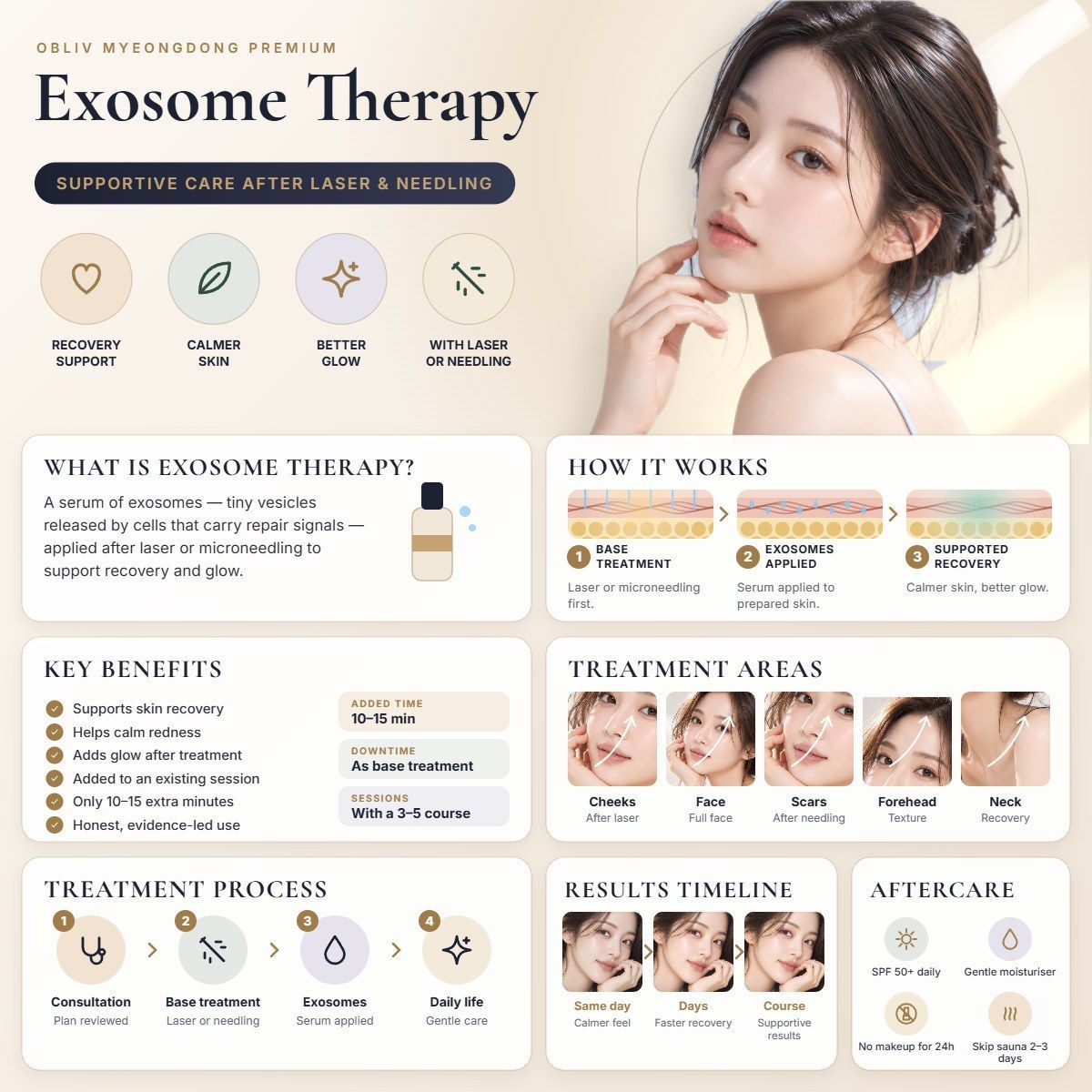
Exosome skin therapy uses a serum containing exosomes (extracellular vesicles), tiny particles released by cells that carry proteins and genetic signals involved in repair. In skin clinics it is most often applied to the skin after laser or microneedling to support recovery, calmness and glow. Evidence is emerging but limited: studies are small and short, products vary widely, and the US FDA has approved no exosome product. At Obliv near Myeongdong and Jongno, Seoul, a doctor explains the evidence and uses exosomes as an add-on, not a replacement for proven treatments.
Key takeaways
- Exosomes are an emerging treatment: early studies are encouraging, but large, high-quality trials are missing.
- There are currently no FDA-approved exosome products; in 2019 the FDA warned about serious adverse events with unapproved injected exosome products.
- In clinics, exosomes are mostly used as a topical serum after laser or microneedling, where they may support recovery and comfort.
- Proven treatments for skin quality, such as Rejuran, Skinvive or laser, should come first; exosomes are an optional add-on.
- Ask what the product is, where it comes from and how it is regulated; a good clinic answers these questions openly.
What are exosomes?
Exosomes are a type of extracellular vesicle: microscopic, membrane-wrapped particles that cells release to communicate with each other. They carry proteins, lipids and small pieces of genetic material such as microRNA. In the lab, exosomes from certain cell types, especially mesenchymal stem cells, influence inflammation, collagen production and wound healing, which is why researchers and skin clinics are interested in them.
Skincare and clinic exosome products are made from very different sources: human stem-cell cultures, plant cells, bacteria, or animal-derived material. They also differ in how they are isolated, purified, measured and preserved. Two products both labelled "exosome" may contain very different things, and this lack of standardisation is one of the main concerns raised by dermatology researchers.
It is important to separate exosomes from stem cell therapy. Exosome products do not contain living cells. They are cell-derived signalling particles, sometimes supplied with culture media or conditioned medium ingredients.

What the evidence actually shows
A 2025 review in the Journal of Drugs in Dermatology concluded that exosomes show promise for skin rejuvenation and hair, but that isolation methods are inconsistent, source material varies, and long-term safety and efficacy still need confirmation in clinical trials. A 2026 scoping review in the same journal found only 17 human studies between 2020 and 2025. Most reported improvements in wrinkles, pigmentation, elasticity, hydration or scars, but sample sizes were small, follow-up was short, most studies had no randomised control group, and conflicts of interest were common.
Those reviews also recorded uncommon but serious adverse events after injected exosomes, including granulomas, tissue necrosis and allergic reactions. That is a key reason we do not inject exosome products into the skin. When applied topically after a laser or microneedling session, the risk profile is mainly that of the main procedure, but the size of any added benefit remains uncertain.
Our honest summary: exosome therapy may help some patients recover more comfortably after procedures and may contribute to skin quality, but it is not yet proven to the standard of hyaluronic acid boosters or established lasers. We think you deserve to know that before paying for it.
How exosomes are used at Obliv: as supportive care
Under Obliv's Skin Architecture method, exosomes are never the main treatment for a concern. We first choose the proven treatment for the layer involved: laser for surface texture, pigment and scars, boosters for dermal quality, lifting for deeper laxity. Exosomes may then be added on the surface to support recovery after laser or microneedling.
The most common combinations are after Pico Fraxel for texture and pores, after microneedling for acne marks, or after gentle laser toning for dull skin. In each case the micro-channels created by the procedure allow a serum to penetrate further than it would on intact skin. For recovery support with stronger evidence, we may suggest LDM skin regeneration or a polynucleotide booster instead.
Ask a doctor about Exosome Skin Therapy
Send a photo and your travel dates on WhatsApp (+82-10-3086-4084). English replies, a personal plan and a written quote before you fly.
Exosomes compared with proven skin boosters
This table puts exosome therapy next to treatments with more established evidence. It is not a ranking of which is 'best', but of how confident we can be about what each does. If your budget is limited, we usually recommend investing first in a treatment from the lower rows, and adding exosomes only if you want to. See our overview of all skin boosters for more detail.
| Option | What it is | Evidence level | Main role | Regulatory status (US) |
|---|---|---|---|---|
| Exosome serum (topical) | Cell-derived vesicles | Emerging; small studies | Recovery support after laser | No FDA-approved product |
| Skinvive (HA) | HA microdroplets | Randomised regulatory trial | Hydration and smoothness | FDA-approved (cheeks) |
| Rejuran (PN) | Polynucleotide | Growing RCTs, small sizes | Repair, texture, scars | Approved in Korea, not US |
| Juvelook (PDLLA) | Collagen stimulator | Early clinical studies | Collagen, pores, firmness | Approved in Korea, not US |
| Stem cell skin therapy | Cell-culture-derived products | Limited | Supportive regenerative care | Product-dependent |
Who might consider exosome therapy?
Exosome add-ons may be worth considering if you are already having a laser or microneedling course, your skin tends to stay red or tight for longer than you would like after procedures, and you understand the evidence is still early. Patients with dull, dehydrated skin or large pores often ask about it as part of a glow or texture plan.
We advise against it during pregnancy or breastfeeding, with active infection, and if you have a history of cancer without your specialist's agreement, because exosomes carry growth-related signals whose long-term effects are not well understood.
Your appointment step by step
The product name, source and batch details are recorded in your Skin Library, so you or your home doctor can see exactly what was used.
- Before you travel: send photos and travel dates on WhatsApp, and tell us what you have read about exosomes so we can answer your questions.
- Consultation and Mark-Vu imaging: the doctor chooses the main treatment and explains whether an exosome add-on makes sense.
- Main procedure: laser or microneedling as planned, with numbing if needed.
- Exosome application: the serum is applied to the treated skin and gently massaged in; about 10–15 minutes.
- Soothing and aftercare: calming care and written instructions for the following days.
Recovery and results timeline
Because exosomes are applied with another procedure, downtime is set by that procedure: usually redness and tightness for one to three days after Pico Fraxel or microneedling. Some patients report that their skin feels comfortable sooner with an exosome add-on, though this has not been firmly proven in large studies.
Changes in texture and tone build mainly through the laser or microneedling course over two to four months. How long any additional benefit from exosomes lasts is not well established, so we do not quote a duration.
Questions to ask any clinic about exosomes
Because products differ so much, it is worth asking a few direct questions wherever you are treated. A trustworthy clinic will answer them clearly:
- What is the exact product name and manufacturer?
- What is the source: human cells, plant, bacterial or other?
- Is it applied topically or injected, and why?
- How is the product classified and regulated in this country?
- What evidence supports it for my specific concern?
- What would you recommend if I chose not to use exosomes?

Exosome therapy for travellers
For visitors, exosomes are usually added to a laser session booked early in the trip, so that redness has faded before flights and photos. Follow the aftercare of the main procedure, protect your skin from sun while sightseeing, and keep it well moisturised on the plane.
If you want a recovery-focused plan after a long flight, our article on recovering skin after long flights compares options. For a combined glow plan read glass skin package with skin booster.

Cost of exosome add-ons in Seoul
Exosome therapy is usually priced as an add-on to a laser or microneedling session, and cost depends on the product and the area. Because the evidence is still developing, we encourage you to prioritise proven treatments within your budget.
We give a written quote after consultation. See prices and payment, and our tax refund update explaining that Korea's cosmetic VAT refund for foreign visitors ended on 31 December 2025.
Risks, side effects and safety
Every medical aesthetic treatment carries some risk. These are the effects our doctors explain before you consent:
- Redness, tightness and mild swelling, mostly from the laser or microneedling it accompanies.
- Irritation, itching or contact allergy to serum ingredients.
- Infection risk is linked to the open micro-channels; follow hygiene aftercare carefully.
- Breakouts in acne-prone skin, usually mild and temporary.
- Injected exosome products have been linked in reviews to granulomas, necrosis and allergic reactions; we do not inject them.
- Long-term safety data are limited because this is a new field.
Aftercare checklist
- Do not wash the treated skin for the time your doctor advises, usually several hours.
- Avoid make-up for 24 hours after laser or microneedling.
- Skip saunas, jjimjilbang, swimming and intense exercise for 48 hours.
- Pause retinoids, acids and scrubs for 3–5 days.
- Use broad-spectrum sunscreen daily and a hat while sightseeing.
- Use only the gentle products recommended until your skin settles.
- Contact us if redness, pain or swelling increases instead of improving.
Frequently asked questions
What is exosome skin therapy?
It uses a serum containing exosomes, tiny cell-derived vesicles that carry repair-related signals. In clinics it is mainly applied to the skin after laser or microneedling to support recovery.
Are exosomes FDA-approved?
No. The US FDA states that there are currently no FDA-approved exosome products. Regulation in other countries differs by product and classification.
Do exosomes really work?
Early studies are encouraging, with improvements reported in texture, hydration and recovery, but they are small and short-term. Exosomes are best seen as an optional add-on, not a proven stand-alone treatment.
Are exosomes injected?
Some clinics inject them, but serious adverse events have been reported with injected products. At Obliv we apply exosome serums topically after procedures.
Is exosome therapy the same as stem cell therapy?
No. Exosome products do not contain living cells. They contain vesicles released by cells, sometimes from stem-cell cultures.
How many sessions do I need?
Exosomes are usually added to each session of a laser or microneedling course, often 3–5 sessions about 3–6 weeks apart.
Is there downtime?
Downtime comes from the main procedure, usually 1–3 days of redness after laser or microneedling.
Who should not have exosome therapy?
People who are pregnant or breastfeeding, have active skin infection, or have a history of cancer without their specialist's agreement.
Is exosome therapy better than Rejuran?
Rejuran has more clinical evidence for skin repair. Exosomes may support recovery after procedures, but we usually recommend proven boosters first.
Do you offer exosome therapy with English consultations?
Yes. Consultations are in English, and you can message us on WhatsApp at +82-10-3086-4084 with questions before you travel.
Related treatments and guides
From the Obliv Skin Journal
- Microneedling + Skin Booster Korea
- Glass Skin Package + Skin Booster
- Skinvive vs Rejuran Korea
- Recover Your Skin After 15-Hour Flights
- Glass Skin Treatments Safe for Sensitive Skin
Ask a doctor about Exosome Skin Therapy
Send a photo and your travel dates on WhatsApp (+82-10-3086-4084). English replies, a personal plan and a written quote before you fly.
Our five physicians plan every treatment by skin layer using the Obliv Skin Architecture method. Last reviewed 2026-10-27. This page is general information, not a diagnosis; your plan is set after an in-person consultation.
Sources and further reading
- U.S. FDA – Consumer Alert on Regenerative Medicine Products Including Stem Cells and Exosomes
- U.S. FDA – Public Safety Notification on Exosome Products (2019)
- Haykal D et al. Exosomes in Cosmetic Dermatology: A Review of Benefits and Challenges. J Drugs Dermatol, 2025
- Wang OJ et al. Exosome-Based Therapies in Dermatology: A Scoping Review. J Drugs Dermatol, 2026
- American Society of Plastic Surgeons – What are injectable moisturizers, and do you need them?
Explore Botox and fillers by area
Each area has its own anatomy, doses and safety rules. Choose an area for a doctor-reviewed guide with an infographic, typical doses, recovery and FAQs.
Botox by area · overview
- Jaw Botox
- Forehead
- Frown lines
- Crow’s feet
- Bunny lines
- Under-eye
- Brow lift
- Gummy smile
- Lip flip
- Mouth corners
- Chin
- Neck bands
- Skin Botox
- Baby Botox
- Preventative
- Botox for men
- Teeth grinding
- Shoulder
- Calf
- Underarm sweating
Dermal fillers by area · overview
- Nose
- Lips
- Chin
- Jawline
- Cheeks
- Under-eye
- Aegyo-sal
- Temples
- Forehead
- Sunken eyelids
- Smile lines
- Marionette lines
- Lip corners
- Pre-jowl
- Frown lines
- Neck lines
- Hands
- CaHA filler
- Full-face plan
- Filler dissolving
Every plan is made by one of our doctors after an in-person examination.