
Wellness infusion · Doctor-screened
IV Drip in Myeongdong & Jongno, Seoul
An IV drip at Obliv is a simple, doctor-screened infusion of fluid and selected vitamins, given while you rest in a quiet room. We are clear about what it can and cannot do, and we will tell you if it is not right for you.
Quick answer
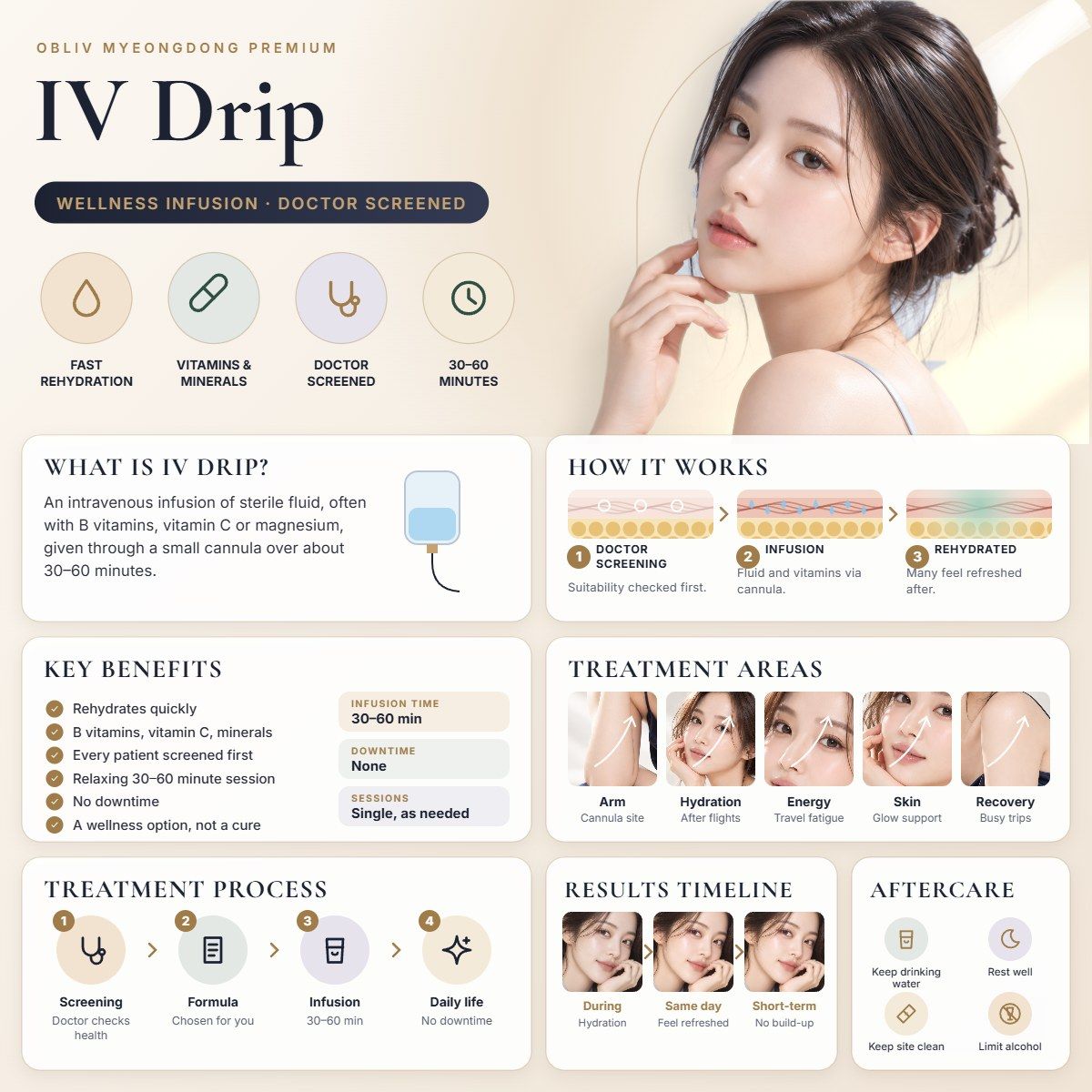
An IV drip is an intravenous infusion of sterile fluid, often with B vitamins, vitamin C or minerals such as magnesium, given through a small cannula in the arm over about 30–60 minutes. It can rehydrate quickly and some people feel refreshed afterwards, but for healthy people it is a wellness option, not a cure, and evidence for broader benefits is limited. At Obliv near Myeongdong and Jongno, Seoul, a doctor screens every patient first; it is unsuitable for some heart, kidney and other conditions.
Key takeaways
- Fluids by vein can correct mild dehydration faster than drinking, which is why travellers ask for drips after long flights or a heavy schedule.
- Vitamin infusions are not proven to boost immunity, cure fatigue or detox the body in healthy people; eating, drinking and sleeping well still matter most.
- Screening is essential: heart failure, kidney disease, uncontrolled high blood pressure, pregnancy and some medicines can make an IV drip unsafe.
- A drip is a medical procedure. It should be prepared under sterile conditions and given with a doctor responsible, not in a spa or hotel room.
- Seek urgent care instead of a drip for severe vomiting, chest pain, confusion, high fever or fainting — call 119 in Korea.
What is an IV drip?
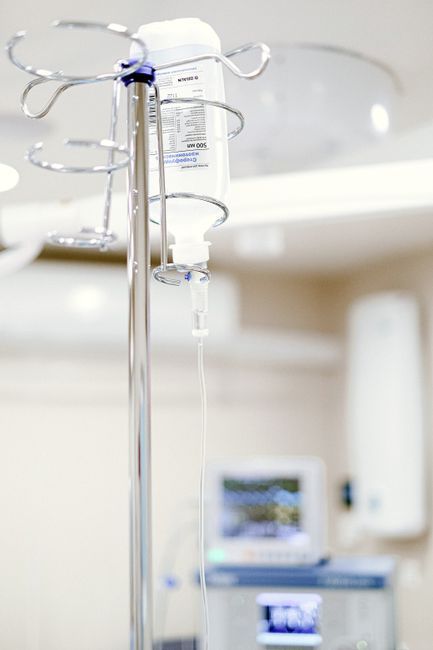
An IV (intravenous) drip delivers a sterile fluid directly into a vein through a thin plastic tube called a cannula. In hospitals, IV fluids are routine medical treatment for dehydration, surgery and illness. In wellness clinics, including many in Seoul, the same technique is used to give a bag of saline or a balanced electrolyte solution, sometimes with added vitamins and minerals, as a short supervised session. In Korea these are often called sueaek (수액), and they are a familiar part of everyday medicine.
Because the fluid bypasses the stomach and gut, it is absorbed fully and quickly. That is genuinely useful if you are dehydrated and finding it hard to drink, or if you need fluids fast for a medical reason. It also explains the appeal for visitors who arrive tired after a long-haul flight, a hot day of sightseeing or a busy business trip.
What an IV drip does not do is change your health in the long term. For most healthy people, the vitamins in a drip are more than the body needs at once, and the excess of water-soluble vitamins is excreted in urine within hours. We think it is important to say this clearly, because many advertisements make much bigger claims than the evidence supports.

What is usually in a wellness IV drip?
The base of every drip is a sterile fluid, typically normal saline (sodium chloride) or Ringer's lactate, a balanced electrolyte solution. Additives vary by clinic and by patient. A doctor chooses the formulation after screening, and the label on the bag should tell you exactly what is in it. Common components include:
- Fluids and electrolytes — saline or Ringer's solution to rehydrate; the part with the clearest benefit when you are dehydrated.
- B-complex vitamins — including thiamine (B1), B6 and B12; these are needed for energy metabolism, but deficiency is uncommon in people with a normal diet.
- Vitamin C (ascorbic acid) — popular in Korea for "brightening" and fatigue drips; high doses need screening for G6PD deficiency and kidney stone history.
- Magnesium and calcium — sometimes added in drips modelled on the so-called Myers' cocktail; small studies have explored them for migraine.
- Glutathione — marketed for skin brightening; evidence for whitening by injection is weak, and we do not recommend it for that purpose. See evidence-based pigmentation treatment instead.

What the evidence says — and what it does not
Reviews by major medical centres such as Cleveland Clinic describe the benefits of IV vitamin therapy for healthy people as uncertain, with few high-quality studies. Fluid and electrolyte replacement does help when you are genuinely dehydrated, for example after illness, heat or a hangover. Some ingredients, such as magnesium, have been studied for migraine, and a few small trials of vitamin infusions in conditions like fibromyalgia found improvement — but not more than in people who received a placebo.
There is no good evidence that IV vitamin drips boost the immune system, "detox" the body, prevent illness, cure chronic fatigue or reverse ageing in healthy people. If you feel persistently exhausted, a doctor should look for causes such as anaemia, thyroid problems or poor sleep, rather than treat the symptom with repeated drips.
We offer IV drips as a supervised wellness and hydration option for people who want one and are safe to have one. The table compares it honestly with simpler alternatives.
| Option | What it does | Evidence in healthy adults | Speed | Notes |
|---|---|---|---|---|
| Water and oral rehydration salts | Replaces fluid and electrolytes | Good for mild dehydration | Within hours | First choice for most travellers |
| Hydration IV (saline or Ringer's) | Fluid straight into the vein | Good when oral intake is hard | Fast | Needs screening; cannula required |
| Vitamin IV (B group, C, magnesium) | Raises blood vitamin levels briefly | Limited; few quality trials | Fast | Excess is largely excreted |
| Balanced diet and supplements | Steady nutrient intake | Good if deficient | Days to weeks | Blood tests show true deficiency |
| Rest and sleep schedule | Resets body clock after jet lag | Good | 1–3 days | Daylight exposure helps |
Ask a doctor about IV Drip
Send a photo and your travel dates on WhatsApp (+82-10-3086-4084). English replies, a personal plan and a written quote before you fly.
Screening and safety: why a doctor checks first
Giving fluid and vitamins directly into a vein removes the body's normal filters. That is why we never start a drip without a doctor reviewing your history. Too much fluid can be dangerous for people with heart failure or kidney disease. High-dose vitamin C can be harmful in G6PD deficiency and in some people with kidney stones. Certain medicines interact with infusion components, and anyone who is pregnant should only receive IV fluids on medical advice.
Safety also depends on how the drip is prepared. The US FDA has highlighted concerns about IV hydration businesses and medical spas compounding infusions under poor conditions, and contaminated IV products have caused serious infections. At Obliv, infusions are prepared with sterile technique by medical staff, from labelled pharmaceutical products, and given in a clinic with a doctor present.
If your symptoms suggest something more serious — heavy vomiting or diarrhoea, chest pain, breathlessness, confusion, a high fever or fainting — a wellness drip is not appropriate. Please go to an emergency department or call 119.
Your IV drip appointment step by step
Many visitors combine a drip with a skin treatment on the same visit, such as a calming LDM session or a skin booster. We schedule the order so you are comfortable, and we always ask whether you have eaten. Our first-visit guide explains arrival and payment.
- Before you come: message us on WhatsApp with your age, medical conditions, medicines and allergies. We confirm whether a drip is likely to be suitable.
- Arrival and vital signs: blood pressure and pulse are checked; you complete a short health questionnaire.
- Doctor screening: the doctor reviews your answers, explains the formulation and the limits of the evidence, and confirms consent.
- Infusion: a nurse places a cannula and the drip runs for about 30–60 minutes in a quiet room while you rest.
- Finish: the cannula is removed, a plaster applied and you rest briefly before leaving.
What to expect during and after the drip
You may feel a cool sensation in the arm as the fluid runs, and some vitamins give a brief warmth, a metallic taste or a vitamin smell. Tell the nurse at once if you feel unwell, short of breath, itchy, or if the site becomes painful or swollen; the drip can be slowed or stopped immediately.
Afterwards, some people feel refreshed and others notice very little — both are normal. Your urine may turn bright yellow for a few hours if B vitamins were included. Any effect is short-term, so we do not recommend frequent repeat drips unless a doctor has identified a specific reason.
IV drips for travellers: jet lag, heat and busy schedules
Jet lag is primarily a body-clock problem, so daylight at the right time, regular meals and sleep are the most effective treatment. Dehydration from dry cabin air can add to tiredness and headaches, and in that situation fluids — by mouth or, if you prefer and are suitable, by drip — can help you feel better. Seoul summers are hot and humid; long days walking around Myeongdong, palaces and markets can also leave you depleted.
If you are planning a recovery day, our journal describes how visitors combine rest, skin care and hydration in jet-lag recovery facial and IV therapy nearby and beauty packages for business travellers. Remember that alcohol, very salty food and little sleep undo most of the benefit.

- Jet Lag Recovery Facial + IV Therapy Nearby
- Jet Lag Face Recovery Program
- Executive Skin Refresh During Business Trips
IV drips and your skin
Korean clinics often market drips for "glass skin", whitening or glow. Hydration can make skin look temporarily less dull, but no drip replaces sunscreen, a good routine or proven treatments. For pigmentation, lasers and topical treatments have far better evidence than injected glutathione or vitamin C; for dryness and dullness, a skin booster works directly in the skin.
Under our Skin Architecture approach, we treat skin concerns layer by layer with tools designed for each layer. An IV drip may be a pleasant part of a recovery day, but we will not sell it to you as a skin treatment. See our dull and dehydrated skin guide for options that work in the skin itself.
IV drip price and what affects it
Price depends on the formulation, the volume of fluid and the time required. A simple hydration drip costs less than one with several additives. Your doctor confirms the formulation after screening, and you receive a written quote before anything is given.
See prices and payment for payment methods. Korea's VAT refund for cosmetic procedures for foreign visitors ended on 31 December 2025; our tax refund update has details.
Risks, side effects and safety
Every medical aesthetic treatment carries some risk. These are the effects our doctors explain before you consent:
- Bruising, discomfort or a small haematoma where the cannula was placed.
- Phlebitis (inflammation of the vein) causing tenderness or redness along the vein for a few days.
- Fluid leaking into the tissue (infiltration), causing temporary swelling at the site.
- Infection at the site or, rarely, in the bloodstream if sterile technique fails.
- Allergic reaction to an ingredient, from itching to, very rarely, anaphylaxis.
- Fluid overload in people with heart or kidney disease, which is why screening matters.
- Light-headedness, flushing, a metallic taste or nausea during the infusion.
Aftercare checklist
- Keep the plaster on for at least 30 minutes and press firmly if the site oozes.
- Avoid heavy lifting with that arm for the rest of the day.
- Keep drinking water and eat a proper meal.
- Avoid alcohol on the day of the drip.
- Watch for spreading redness, warmth, swelling or fever over the next 48 hours and contact us if they appear.
- Seek urgent care (119 in Korea) for chest pain, breathlessness or facial swelling.
Frequently asked questions
Does an IV drip really work?
It rehydrates quickly, which helps if you are dehydrated. Evidence for wider benefits in healthy people — such as immunity, energy or detox — is limited. We offer it as a supervised wellness option, not a cure.
Is an IV drip safe?
For healthy adults who are screened by a doctor and treated with sterile products, serious problems are uncommon. Risks include bruising, vein irritation, infection and allergic reactions, and drips can be dangerous for people with heart or kidney disease.
How long does an IV drip take?
Most infusions take about 30–60 minutes, plus time for screening and a short rest afterwards.
Can an IV drip cure jet lag?
No. Jet lag is a body-clock problem. Fluids may help if you are also dehydrated, but light exposure, regular meals and sleep are the main treatment.
Can an IV drip help a hangover?
Fluids can relieve dehydration-related symptoms. A drip does not speed up how fast your body clears alcohol, and severe vomiting or confusion needs medical care.
Who should not have an IV drip?
People with heart failure, kidney disease, uncontrolled high blood pressure, G6PD deficiency (for high-dose vitamin C), or who are pregnant should not have a wellness drip without specific medical advice. Anyone acutely unwell should go to hospital.
Does a glutathione or vitamin C drip whiten skin?
Evidence is weak and results, if any, are temporary. We do not recommend drips for skin whitening and suggest proven pigmentation treatments instead.
Can I combine an IV drip with a skin treatment?
Yes, often on the same visit. Your doctor plans the order and checks you have eaten and are comfortable.
Do you have English-speaking staff for IV drips near Myeongdong?
Yes. Screening and consultation are available in English. Message us on WhatsApp at +82-10-3086-4084 before your visit.
Related treatments and guides
From the Obliv Skin Journal
- Jet Lag Recovery Facial + IV Therapy Nearby
- Jet Lag Face Recovery Program
- Business Traveler Beauty Packages in Seoul
- Executive Skin Refresh During Business Trips
- Dry Hotel Air Skin Recovery
Ask a doctor about IV Drip
Send a photo and your travel dates on WhatsApp (+82-10-3086-4084). English replies, a personal plan and a written quote before you fly.
Our five physicians plan every treatment by skin layer using the Obliv Skin Architecture method. Last reviewed 2026-10-27. This page is general information, not a diagnosis; your plan is set after an in-person consultation.
Sources and further reading
Explore Botox and fillers by area
Each area has its own anatomy, doses and safety rules. Choose an area for a doctor-reviewed guide with an infographic, typical doses, recovery and FAQs.
Botox by area · overview
- Jaw Botox
- Forehead
- Frown lines
- Crow’s feet
- Bunny lines
- Under-eye
- Brow lift
- Gummy smile
- Lip flip
- Mouth corners
- Chin
- Neck bands
- Skin Botox
- Baby Botox
- Preventative
- Botox for men
- Teeth grinding
- Shoulder
- Calf
- Underarm sweating
Dermal fillers by area · overview
- Nose
- Lips
- Chin
- Jawline
- Cheeks
- Under-eye
- Aegyo-sal
- Temples
- Forehead
- Sunken eyelids
- Smile lines
- Marionette lines
- Lip corners
- Pre-jowl
- Frown lines
- Neck lines
- Hands
- CaHA filler
- Full-face plan
- Filler dissolving
Every plan is made by one of our doctors after an in-person examination.