Ultrasound care · Calming & recovery
LDM Skin Regeneration in Myeongdong & Jongno, Seoul
LDM is a gentle, painless ultrasound treatment that many Korean clinics use to calm reactive skin, boost hydration and help the skin recover after laser. It takes about 20–30 minutes and you can go straight back to your day.
Quick answer
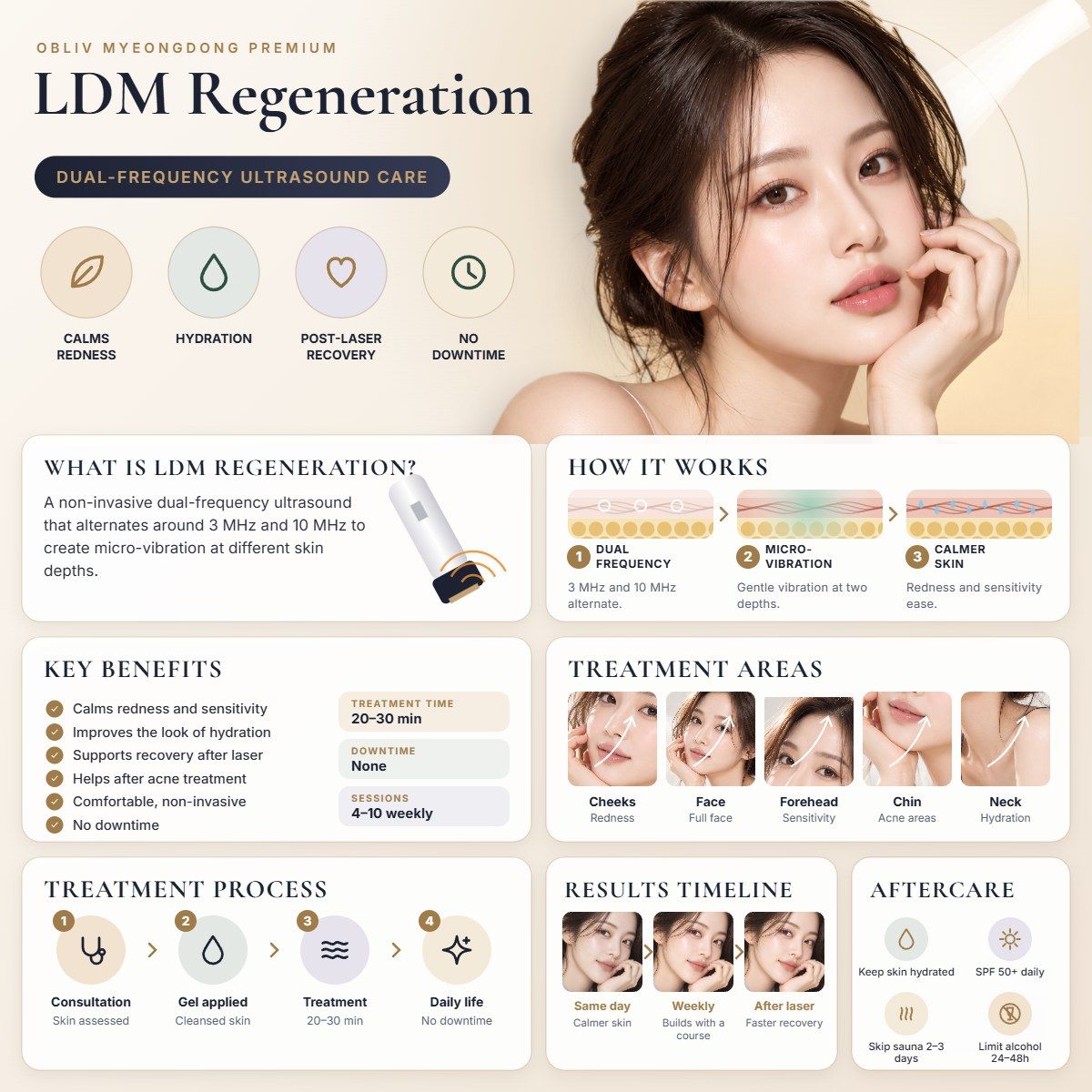
LDM (Local Dynamic Micro-massage) skin regeneration is a non-invasive dual-frequency ultrasound treatment that rapidly alternates two frequencies, typically around 3 MHz and 10 MHz, to create micro-vibration at different skin depths. It is used to calm redness and sensitivity, improve the look of hydration and support recovery after laser or acne treatment. At Obliv near Myeongdong and Jongno, Seoul, a session takes 20–30 minutes with no downtime; a short course of 4–10 sessions, often weekly, gives the best results, and single sessions are popular after flights.
Key takeaways
- LDM is low-intensity ultrasound, not heat-based lifting like HIFU; it feels like a cool, smooth massage and has no downtime.
- The "dynamic" part means the device switches between frequencies many times per second, so energy works at more than one depth.
- Best uses: calming redness and sensitivity, hydration and glow, and post-laser or post-acne recovery.
- Clinical studies exist but are small; LDM is a supportive treatment, not a replacement for proven acne medicines or lasers.
- Short trip? One session before a big day or after a long-haul flight is a common, sensible use.
What is LDM skin regeneration?
LDM stands for Local Dynamic Micro-massage, a German-developed ultrasound technology widely used in Korean skin clinics. Unlike the focused, high-intensity ultrasound used for lifting, LDM uses low-intensity ultrasound delivered through a flat handpiece that glides over a gel. The key feature is that the device alternates between two frequencies — commonly about 3 MHz and 10 MHz — many times per second, producing rapid pressure changes in the tissue that the manufacturer describes as a micro-massage at a cellular level.
Different ultrasound frequencies reach different depths. Higher frequencies are absorbed closer to the surface, while lower frequencies travel further into the dermis. By switching quickly between them, the treatment works on more than one layer in one pass. Newer versions add a third frequency, and researchers have studied both dual- and triple-frequency protocols.
In practice, Korean doctors use LDM as a calming and recovery treatment: after lasers, alongside acne care, for sensitive or rosacea-prone skin, and as a pure hydration and glow session for visitors whose skin has been stressed by travel. It is painless, needs no numbing and leaves no marks, so it fits easily around a busy Seoul itinerary.

How dual-frequency ultrasound works on the skin
Ultrasound is a mechanical wave. At the low intensities used in LDM, it does not cut, burn or heat tissue significantly. Instead, the alternating frequencies create fast cycles of gentle compression and decompression. Researchers who study the technique propose that this mechanical stimulation influences how skin cells signal to each other — including proposed effects on inflammation, on the extracellular matrix and on proteins involved in repair. These mechanisms are still being studied and should be treated as hypotheses rather than settled science.
What patients notice is simpler: skin that looks less red, feels less tight and absorbs moisture more comfortably. Because the effect is gentle, LDM is often combined with other steps in one visit:
- After laser — a session right after toning, Pico Fraxel or fractional laser to support calmer recovery.
- With acne care — alongside extraction, prescribed treatment or a medical facial; see acne and breakouts.
- For redness and sensitivity — a short course for reactive skin, as described in our redness and sensitive skin guide.
- With regenerative products — LDM before or after an exosome or booster step.
- Eye area — gentle passes for puffiness and tired-looking under-eyes after flights.

What the research says
LDM has a modest but growing body of published research. A retrospective two-centre study in the Journal of Cosmetic Dermatology (2024) followed 24 adults with mild to severe acne treated with triple-frequency LDM alone, without acne medicines, and reported large reductions in acne severity scores at the end of treatment and at follow-up, with only brief redness as a side effect. A separate case series in Clinical, Cosmetic and Investigational Dermatology (2024) reported improvement in cellulite and tissue firmness after triple-frequency ultrasound.
These are encouraging results, but they come from small studies without control groups, which means we cannot be sure how much improvement was due to the device itself. We therefore present LDM as a helpful supportive treatment with a very good comfort and safety profile, not as a stand-alone cure for acne or a replacement for evidence-based acne treatment.
Our doctors use Mark-Vu imaging before and after a course to check whether redness and texture really improved for you. If they did not, we change the plan rather than adding more sessions.

Ask a doctor about LDM Skin Regeneration
Send a photo and your travel dates on WhatsApp (+82-10-3086-4084). English replies, a personal plan and a written quote before you fly.
LDM compared with HIFU, boosters and exosomes
Because "ultrasound" appears in both, LDM is often confused with HIFU. They are opposite ends of the same physics: HIFU focuses high-intensity energy to create tiny heat points in the deep layers for lifting, while LDM uses diffuse, low-intensity energy for calming and recovery. If your goal is tightening the jawline, HIFU or Ultherapy is the appropriate tool. If your goal is calmer, more comfortable skin, LDM is a better fit.
Injectable boosters work at a different level again: they deliver hyaluronic acid or polynucleotides directly into the dermis for longer-lasting hydration or repair, at the cost of small bumps for a day or two. The table shows how we choose.
| Option | Energy type | Main goal | Downtime | Feels like |
|---|---|---|---|---|
| LDM skin regeneration | Low-intensity dual-frequency ultrasound | Calming, hydration, recovery | None | Cool, smooth massage |
| HIFU lifting | High-intensity focused ultrasound | Lifting and tightening | None to mild | Deep hot pinpricks |
| Exosome therapy | Topical regenerative product | Recovery and glow | 0–2 days | Cool serum, light tingling |
| Skin booster | Hyaluronic acid injection | Deep hydration, fine lines | 1–3 days bumps | Small pinches |
| Rejuran | Polynucleotide injection | Repair, thin and tired skin | 1–3 days bumps | Pinches; numbing used |
Who is a good candidate for LDM?
LDM suits almost every skin type, including very sensitive skin, because it involves no heat, needles or chemicals. It is particularly popular with travellers whose skin reacts to climate change, dry cabin air and new products, and with patients who want to recover faster between laser sessions. Our journal covers this in a jet-lag face recovery programme in Seoul.
It is not the right choice if you need lifting, fat reduction or scar remodelling, and it should not replace medical treatment for cystic or severe acne. We also avoid treating over active infections or cold sores, and ask about implanted electronic devices and pregnancy before any session.
Your LDM session step by step
When LDM is combined with laser, we usually perform it immediately after the laser step to support calm recovery. With injectable boosters, the order depends on the product; your doctor explains the sequence on the day. See our first-visit guide for arrival and consultation details.
- Before you arrive: tell us on WhatsApp what you want to improve and whether you are also booking laser or boosters, so we schedule the order correctly.
- Cleansing and Mark-Vu imaging: make-up is removed and redness, hydration and texture are recorded.
- Doctor check: a brief review to confirm LDM suits your skin and to set frequency mode and time per area.
- Treatment: 20–30 minutes of gliding passes over conductive gel. You feel coolness and a light vibration only.
- Finish: gel removed, a calming moisturiser and sunscreen applied. You can wear make-up and go straight out.
Results timeline
Single sessions give a short-lived calming and hydrating effect that many people notice the same day. Longer-term improvements in reactivity, redness and texture come from a course, typically weekly or every one to two weeks. Visitors in Seoul for a short stay often book two or three sessions spread across their trip, then decide whether a maintenance plan at home makes sense.
LDM for travellers: flights, hotel air and events
Long-haul flights expose skin to very low humidity for many hours, and hotel air-conditioning continues the effect. Add pollution, new skincare and late nights, and many visitors arrive with tight, flushed or breakout-prone skin. A single LDM session early in the trip is an easy, low-risk way to reset, and it can be paired with a hydrating skin booster if you have a few days for small bumps to settle.
Because there is no downtime, LDM is also useful on the day before a wedding, a photoshoot or an important meeting. For a fuller programme combining LDM, hydration and IV support, read jet-lag recovery facial and IV therapy or our guide to dry hotel air skin recovery.

LDM price and what affects it
LDM is one of the more affordable treatments in a Korean skin plan, and it is often added to another procedure rather than booked alone. Cost depends on the treatment time, the number of areas (face, eyes, neck) and whether you choose a single session or a course.
We provide a written quote after consultation. Payment information is on our prices and payment page, and the end of Korea's cosmetic VAT refund for foreign visitors on 31 December 2025 is explained in our tax refund update.
Risks, side effects and safety
Every medical aesthetic treatment carries some risk. These are the effects our doctors explain before you consent:
- Brief, mild redness or warmth in very sensitive skin, usually gone within an hour.
- Mild tingling during treatment of thin areas such as the eye contour.
- Irritation or breakouts from the conductive gel in rare cases; tell us about known sensitivities.
- Not suitable over active infection, cold sores or open wounds, where it may worsen irritation.
- Limited response: some people notice only a small improvement, as with any supportive treatment.
Aftercare checklist
- No special restrictions; you can return to sightseeing, work or shopping immediately.
- Keep your routine gentle for 24 hours, especially if LDM followed laser.
- Moisturise well and drink water, particularly on flight days.
- Apply SPF 50 every morning; calmer skin still needs sun protection.
- For a course, keep a regular interval (often weekly) for best results.
- Message us on WhatsApp if redness or irritation persists beyond a day.
Frequently asked questions
What does LDM stand for?
LDM stands for Local Dynamic Micro-massage. It is a low-intensity ultrasound technology that rapidly alternates between two or more frequencies to work at different skin depths.
Does LDM hurt?
No. It feels like a cool, smooth massage with a slight vibration. No numbing is needed.
Is LDM the same as HIFU?
No. HIFU uses high-intensity, focused ultrasound to heat deep layers for lifting. LDM uses low-intensity, non-focused ultrasound for calming, hydration and recovery, with no heat damage.
How many LDM sessions do I need?
A single session gives a short-term calming effect. For sensitive skin or acne support, 4–10 sessions, often weekly, are typical. After laser, one session is often enough.
Is there downtime after LDM?
No. You can wear make-up and return to your day straight away.
Can LDM treat acne?
Small studies suggest LDM can help reduce acne severity, but evidence is limited. We use it as a supportive treatment alongside proper acne care, not instead of it.
Can I have LDM after laser on the same day?
Yes. LDM is commonly used immediately after laser treatments to support calmer, more comfortable recovery.
Is LDM safe for sensitive skin and rosacea?
Generally yes, because it involves no heat or needles. Your doctor checks your skin first and adjusts settings for very reactive skin.
Is LDM safe in pregnancy?
Data are limited, so as a precaution we discuss timing with you and avoid treatment unless your own doctor agrees.
Do you offer English consultations for LDM near Myeongdong?
Yes. Message us on WhatsApp at +82-10-3086-4084 in English to book or ask questions before you travel.
Related treatments and guides
From the Obliv Skin Journal
- Jet Lag Recovery Facial + IV Therapy Nearby
- Jet Lag Face Recovery Program
- Dry Hotel Air Skin Recovery
- Glass Skin Treatments Safe for Sensitive Skin
- Acne Treatment Without Peeling
Ask a doctor about LDM Skin Regeneration
Send a photo and your travel dates on WhatsApp (+82-10-3086-4084). English replies, a personal plan and a written quote before you fly.
Our five physicians plan every treatment by skin layer using the Obliv Skin Architecture method. Last reviewed 2026-10-27. This page is general information, not a diagnosis; your plan is set after an in-person consultation.
Sources and further reading
- A Retrospective Pragmatic Two-Center Clinical Study of Triple-Frequency Ultrasound in Acne Vulgaris – J Cosmet Dermatol (PMC)
- Triple-Frequency Ultrasound for Cellulite: A Retrospective Case-Series – Clin Cosmet Investig Dermatol (DOAJ)
- Dermatology Times – Study reveals acne severity reduction with TF-LDM
Explore Botox and fillers by area
Each area has its own anatomy, doses and safety rules. Choose an area for a doctor-reviewed guide with an infographic, typical doses, recovery and FAQs.
Botox by area · overview
- Jaw Botox
- Forehead
- Frown lines
- Crow’s feet
- Bunny lines
- Under-eye
- Brow lift
- Gummy smile
- Lip flip
- Mouth corners
- Chin
- Neck bands
- Skin Botox
- Baby Botox
- Preventative
- Botox for men
- Teeth grinding
- Shoulder
- Calf
- Underarm sweating
Dermal fillers by area · overview
- Nose
- Lips
- Chin
- Jawline
- Cheeks
- Under-eye
- Aegyo-sal
- Temples
- Forehead
- Sunken eyelids
- Smile lines
- Marionette lines
- Lip corners
- Pre-jowl
- Frown lines
- Neck lines
- Hands
- CaHA filler
- Full-face plan
- Filler dissolving
Every plan is made by one of our doctors after an in-person examination.