
Regenerative care · Skin quality
Stem Cell Skin Therapy in Myeongdong & Jongno, Seoul
"Stem cell" facials are popular in Korea, but the name is often misunderstood. Here we explain plainly what is actually used, what the evidence does and does not show, and when it is a sensible add-on to your skin plan.
Quick answer
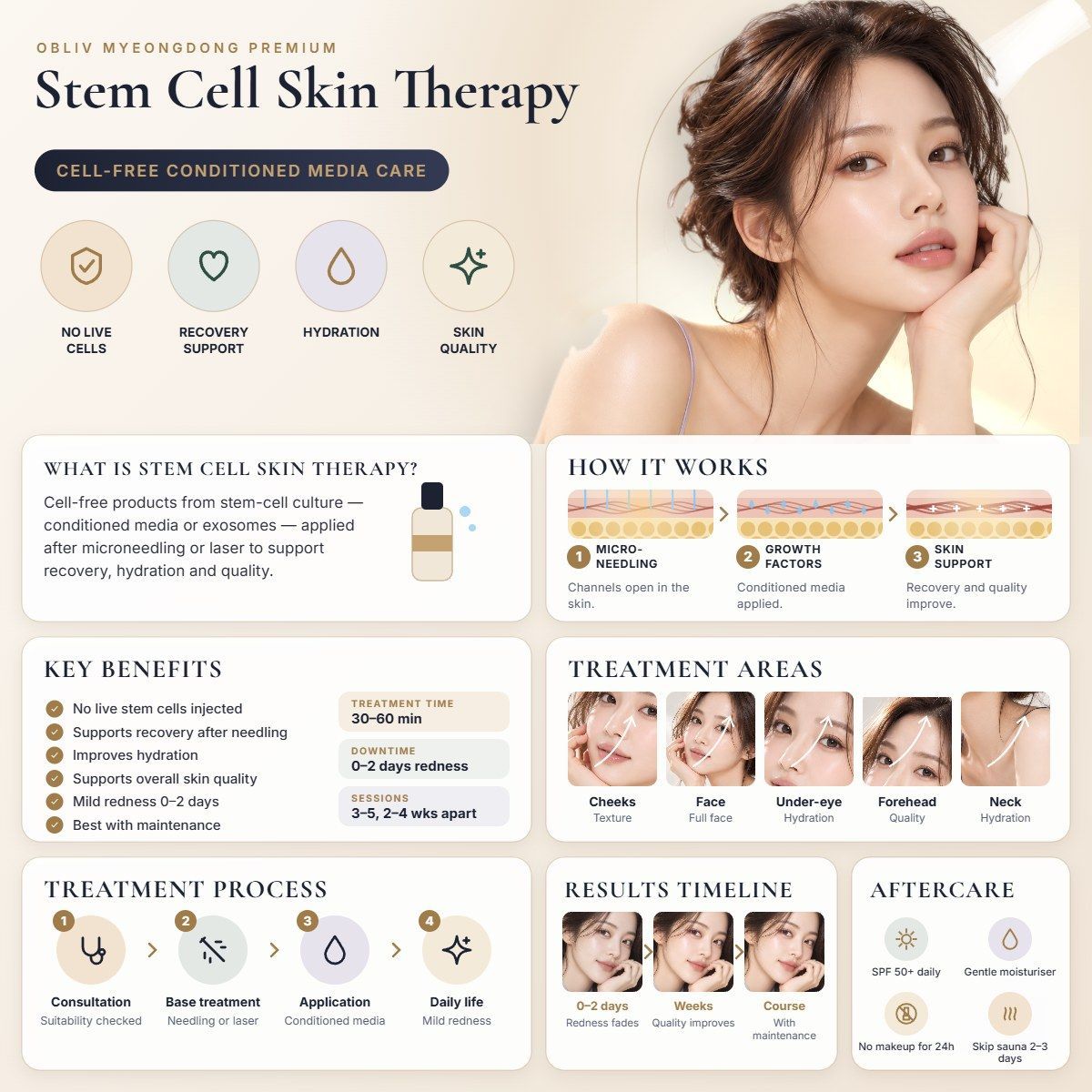
Stem cell skin therapy, in aesthetic clinics, almost always means applying cell-free products made from stem-cell culture — conditioned media (growth factors and proteins released by cultured cells) or exosomes (extracellular vesicles) — after microneedling or laser to support recovery, hydration and skin quality. It does not inject live stem cells. Evidence is early and mostly from small studies. At Obliv near Myeongdong and Jongno, Seoul, it is used as a supportive add-on, usually 30–60 minutes, with 0–2 days of mild redness and a course of 3–5 sessions.
Key takeaways
- Cosmetic "stem cell" treatments in clinics use products derived from stem-cell culture, not living stem cells injected into the face.
- The most reasonable use is recovery support: calming and hydrating skin after laser or microneedling.
- Clinical evidence is promising but early: small, often industry-funded studies with short follow-up. Proven tools for wrinkles and scars should come first.
- Regulation differs by country. The US FDA has approved no exosome products and warns consumers about unapproved stem-cell and exosome claims.
- Be wary of anyone promising live stem-cell injections for anti-ageing, cures or permanent results.
What is stem cell skin therapy — and what it is not
Stem cells are cells that can renew themselves and turn into specialised cell types. In medicine, the only well-established stem-cell treatments are blood-forming stem cell transplants for blood and immune diseases. The US Food and Drug Administration states that the only stem-cell products it has approved are blood-forming cells from umbilical cord blood, for disorders of blood production — none for cosmetic use.
So what happens in a "stem cell facial" in Seoul? In almost every legitimate aesthetic clinic, the product contains no living stem cells at all. Instead, cells such as adipose-derived or umbilical-cord mesenchymal stromal cells are grown in a laboratory, and the liquid they grow in is collected and purified. This conditioned medium contains growth factors, cytokines and proteins the cells release. Some products go further and isolate exosomes, tiny extracellular vesicles that carry proteins and genetic signals between cells.
These cell-free products are then applied to skin, usually immediately after microneedling, a fractional laser or another treatment that creates temporary microchannels. The aim is to support the skin's own repair signals. That is a reasonable idea with some early supporting data — but it is very different from the promise of injecting stem cells to regrow young skin, and we think you should know that before you book anything.

Conditioned media, exosomes and growth factors explained
Skin repair is driven by signalling. After injury, cells in the epidermis and dermis release growth factors that tell fibroblasts to make collagen, help blood vessels form and calm inflammation. Products derived from stem-cell culture are designed to supply a concentrated mix of those signals at the moment the skin is repairing itself after a procedure.
Several types appear in Korean clinics and cosmeceuticals. Understanding the labels helps you compare options honestly:
- Stem-cell conditioned media (CM) — the filtered culture fluid, sometimes listed as "adipose stem cell conditioned media" or "cord blood stem cell culture extract". Rich in growth factors such as EGF, VEGF and TGF-β.
- Exosomes / extracellular vesicles (EVs) — nanoscale vesicles separated from conditioned media. See our dedicated exosome skin therapy page.
- Plant "stem cell" extracts — from apple, grape or edelweiss cell culture. These are antioxidant cosmetic ingredients; they do not behave like human stem cells in skin.
- Autologous fat or cell injections — taking your own fat or processed cells and re-injecting them. This is a surgical procedure in a different regulatory category and is not what we offer as stem cell skin therapy.

What the evidence shows so far
Laboratory and animal research on mesenchymal stromal cell secretions is extensive, and systematic reviews describe encouraging signals for wound healing, skin regeneration, hair and pigmentation. Human cosmetic studies are fewer and usually small, of short duration and often funded by manufacturers. Many combine conditioned media with microneedling or laser and compare against the procedure alone, which makes it hard to separate the effect of the product.
Taken together, the honest summary is that cell-free stem-cell products may help skin recover faster and feel calmer after procedures, and may modestly support texture and glow. They are not a proven stand-alone treatment for deep wrinkles, sagging, acne scars or melasma. For those, energy devices, injectables and established boosters have better evidence — which is why our comparison table places them alongside each other rather than presenting stem cell therapy as a replacement.
We will continue to update this page as better-quality trials are published, and our doctors are happy to explain the specific product used and what is known about it at your consultation.
| Option | What it is | Evidence level | Downtime | Best for |
|---|---|---|---|---|
| Stem-cell conditioned media | Cell-free growth factors from culture | Early; small studies | 0–2 days | Recovery after procedures |
| Exosome skin therapy | Extracellular vesicles from culture | Early; growing interest | 0–2 days | Calming, glow, post-laser care |
| Rejuran (PDRN) | Polynucleotide injection | Moderate in Korea and Asia | 1–3 days bumps | Thin, tired skin, texture |
| Skin booster (HA) | Hyaluronic acid micro-injections | Moderate to good | 1–3 days bumps | Hydration, fine crepey lines |
| Fractional laser | Energy-based collagen remodelling | Good for scars and texture | 1–7 days | Scars, pores, texture |
Ask a doctor about Stem Cell Skin Therapy
Send a photo and your travel dates on WhatsApp (+82-10-3086-4084). English replies, a personal plan and a written quote before you fly.
Regulation and safety: what international patients should know
Regulation of regenerative products is complex and varies by country. In the United States, the FDA states that exosome products intended to treat disease generally require approval, that none are currently approved, and it has issued consumer alerts and safety notices about clinics marketing unapproved stem-cell and exosome treatments. Many products used in aesthetic clinics worldwide are sold as cosmetics for topical application rather than as medicines.
In Korea, products used on skin after procedures are typically supplied as cosmetic ingredients or medical-grade topical products, and cell-based medicines are regulated separately. Rules can change, and what is permitted in Korea may not be permitted in your home country, so if you are planning further treatment at home, ask your local doctor before relying on the same product being available.
At Obliv we use only products from traceable suppliers, applied by medical staff in a clean clinical environment, and we record the product name and batch in your Skin Library. We do not offer live-cell injections for cosmetic purposes.

Who is a good candidate?
The people who tend to be happiest with stem-cell-derived skin therapy are those who want a gentle, supportive step alongside proven treatments, or a quick refresh with almost no downtime. It is often chosen by visitors whose skin feels tight and stressed after long flights, dry hotel air and city pollution — see dry hotel air skin recovery in Seoul.
It is not the right first choice if your main concern is deep lines, laxity or scarring. For those, start with acne scar treatment, lifting or targeted injectables, and consider a regenerative product as a recovery partner. Because data in pregnancy and in people with a history of cancer are lacking, we take a cautious approach and may decline treatment.
Your appointment step by step
Many visitors add this step to another treatment on the same day rather than booking it alone. A common combination is laser toning or Pico Fraxel followed by a regenerative product and cooling, or a gentle ultrasound session such as LDM skin regeneration.
- Before you fly: send photos and your main concern on WhatsApp; we tell you honestly whether this treatment is useful for it.
- Mark-Vu skin analysis: hydration, redness, pores and texture are recorded as a baseline.
- Doctor consultation: we explain which product would be used, the evidence, and how it fits with any other treatment.
- Base treatment: gentle microneedling, a fractional laser pass, or ultrasound such as LDM to prepare the skin.
- Application and soothing: the product is applied and a calming mask finishes the session, about 30–60 minutes in total.
Results and recovery timeline
Most patients notice that skin feels calmer and more hydrated within a day or two, especially after a procedure. Changes in texture and tone, if they happen, build slowly over a course of sessions. Because the effect is supportive, results depend heavily on the base treatment, your skincare and sun protection between visits.
How it fits with Rejuran, skin boosters and laser
Korean skin plans often layer several mechanisms. A hyaluronic acid skin booster adds water-binding hydration, a polynucleotide treatment such as Rejuran or salmon DNA injection supports tissue repair, and energy devices remodel collagen. A stem-cell-derived product sits in this toolbox as a recovery aid, not as the centrepiece.
Under our Skin Architecture approach, the doctor decides which layer needs help first. If the surface barrier is irritated, calming comes first. If the dermis is thin and tired, a booster may matter more. If texture or scarring is the main issue, laser or microneedling leads and the regenerative product follows. That order is what makes a plan worth its cost.

Cost and what affects the price
Price depends mainly on the base treatment it is combined with, the product chosen and the number of sessions. A regenerative product added to a laser session is priced very differently from a stand-alone course. Your written quote lists each item separately, so you can decide whether the add-on is worth it for you.
See prices and payment for payment methods and our tax refund update for the end of Korea's cosmetic VAT refund for foreign visitors on 31 December 2025.
Risks, side effects and safety
Every medical aesthetic treatment carries some risk. These are the effects our doctors explain before you consent:
- Temporary redness, warmth and mild swelling after the base treatment, usually settling within 1–2 days.
- Stinging or itching when the product is applied to freshly microneedled skin.
- Irritant or allergic contact reactions to product ingredients; a patch test may be offered if you react easily.
- Breakouts or small bumps in acne-prone skin.
- Infection is rare but possible whenever skin is microneedled; clean technique and aftercare reduce the risk.
- Unknown long-term effects: most products have limited long-term human safety data.
Aftercare checklist
- Keep skin clean and avoid make-up for 12–24 hours if microneedling was used.
- Use a gentle cleanser and plain moisturiser; skip acids, retinoids and scrubs for 3–5 days.
- Wear SPF 50 daily and reapply when outdoors.
- Avoid saunas, jjimjilbang and hard exercise for 24–48 hours.
- Do not apply leftover clinic products at home unless your doctor gives them to you for that purpose.
- Message us on WhatsApp if redness, itching or swelling increases rather than fades.
Frequently asked questions
Does stem cell skin therapy use real stem cells?
Not in a cosmetic clinic setting. The products are cell-free: conditioned media or exosomes collected from stem cells grown in a laboratory. No living stem cells are injected into your skin.
Is stem cell skin therapy proven to work?
Evidence is early. Small studies suggest these products may help skin recover after laser or microneedling and may modestly improve texture and hydration, but large, independent, long-term trials are lacking.
Is it safe?
When cell-free products from traceable suppliers are applied by medical staff, side effects are usually mild and short-lived. Long-term safety data are limited, and we take a cautious approach in pregnancy and with cancer history.
What is the difference between stem cell therapy and exosome therapy?
Exosomes are one component separated from stem-cell conditioned media. "Stem cell therapy" products may contain the broader mix of growth factors and proteins; exosome products are more specifically purified vesicles. Both are cell-free. See our exosome page.
Will it remove wrinkles?
Not on its own. Deep wrinkles respond better to Botox, fillers, boosters and lifting devices. Stem-cell-derived products are best viewed as supportive skin-quality care.
How many sessions do I need?
Most people who choose it do 3–5 sessions about 2–4 weeks apart, usually combined with another treatment. One session can be useful as recovery support after laser.
Is there downtime?
Usually very little. Mild redness for up to a day or two, mostly from the microneedling or laser used beforehand.
Can I bring the same treatment home?
Regulations differ by country, and the same products may not be available or permitted at home. Ask your local doctor, and keep the product details from your Skin Library record.
Do you speak English?
Yes. English consultations are available, and you can message us on WhatsApp at +82-10-3086-4084 before you travel.
Related treatments and guides
From the Obliv Skin Journal
- Glass Skin Package + Skin Booster
- Microneedling + Skin Booster Korea
- Dry Hotel Air Skin Recovery
- Jet Lag Face Recovery Program
- Glass Skin Treatments Safe for Sensitive Skin
Ask a doctor about Stem Cell Skin Therapy
Send a photo and your travel dates on WhatsApp (+82-10-3086-4084). English replies, a personal plan and a written quote before you fly.
Our five physicians plan every treatment by skin layer using the Obliv Skin Architecture method. Last reviewed 2026-10-27. This page is general information, not a diagnosis; your plan is set after an in-person consultation.
Sources and further reading
- US FDA – Consumer Alert on Regenerative Medicine Products Including Stem Cells and Exosomes
- US FDA – Important Patient and Consumer Information About Regenerative Medicine Therapies
- US FDA – Public Safety Alert Due to Marketing of Unapproved Stem Cell and Exosome Products
- Mesenchymal Stromal Cell-Conditioned Medium for Skin Diseases: A Systematic Review (PMC)
- Exosomes for Aesthetic Dermatology: A Comprehensive Literature Review and Update (PMC)
Explore Botox and fillers by area
Each area has its own anatomy, doses and safety rules. Choose an area for a doctor-reviewed guide with an infographic, typical doses, recovery and FAQs.
Botox by area · overview
- Jaw Botox
- Forehead
- Frown lines
- Crow’s feet
- Bunny lines
- Under-eye
- Brow lift
- Gummy smile
- Lip flip
- Mouth corners
- Chin
- Neck bands
- Skin Botox
- Baby Botox
- Preventative
- Botox for men
- Teeth grinding
- Shoulder
- Calf
- Underarm sweating
Dermal fillers by area · overview
- Nose
- Lips
- Chin
- Jawline
- Cheeks
- Under-eye
- Aegyo-sal
- Temples
- Forehead
- Sunken eyelids
- Smile lines
- Marionette lines
- Lip corners
- Pre-jowl
- Frown lines
- Neck lines
- Hands
- CaHA filler
- Full-face plan
- Filler dissolving
Every plan is made by one of our doctors after an in-person examination.