
Lifting · High-intensity focused ultrasound
HIFU Lifting in Myeongdong & Jongno, Seoul

Lifting · High-intensity focused ultrasound

HIFU Lifting in Myeongdong & Jongno, Seoul

HIFU lifting focuses ultrasound energy into tiny heat points under the skin to firm the jawline, cheeks and under-chin without needles or incisions. At Obliv near Myeongdong and Jongno, a doctor chooses the depths and line counts for each zone of your face.

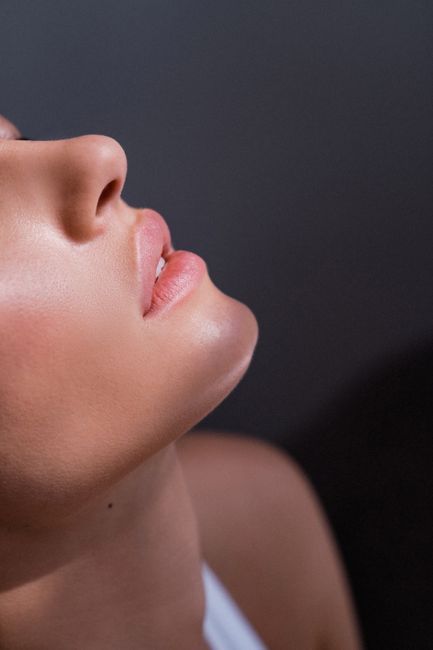
Doctor performing HIFU focused ultrasound lifting on the jawline at Obliv Clinic near Myeongdong, Seoul

Quick answer

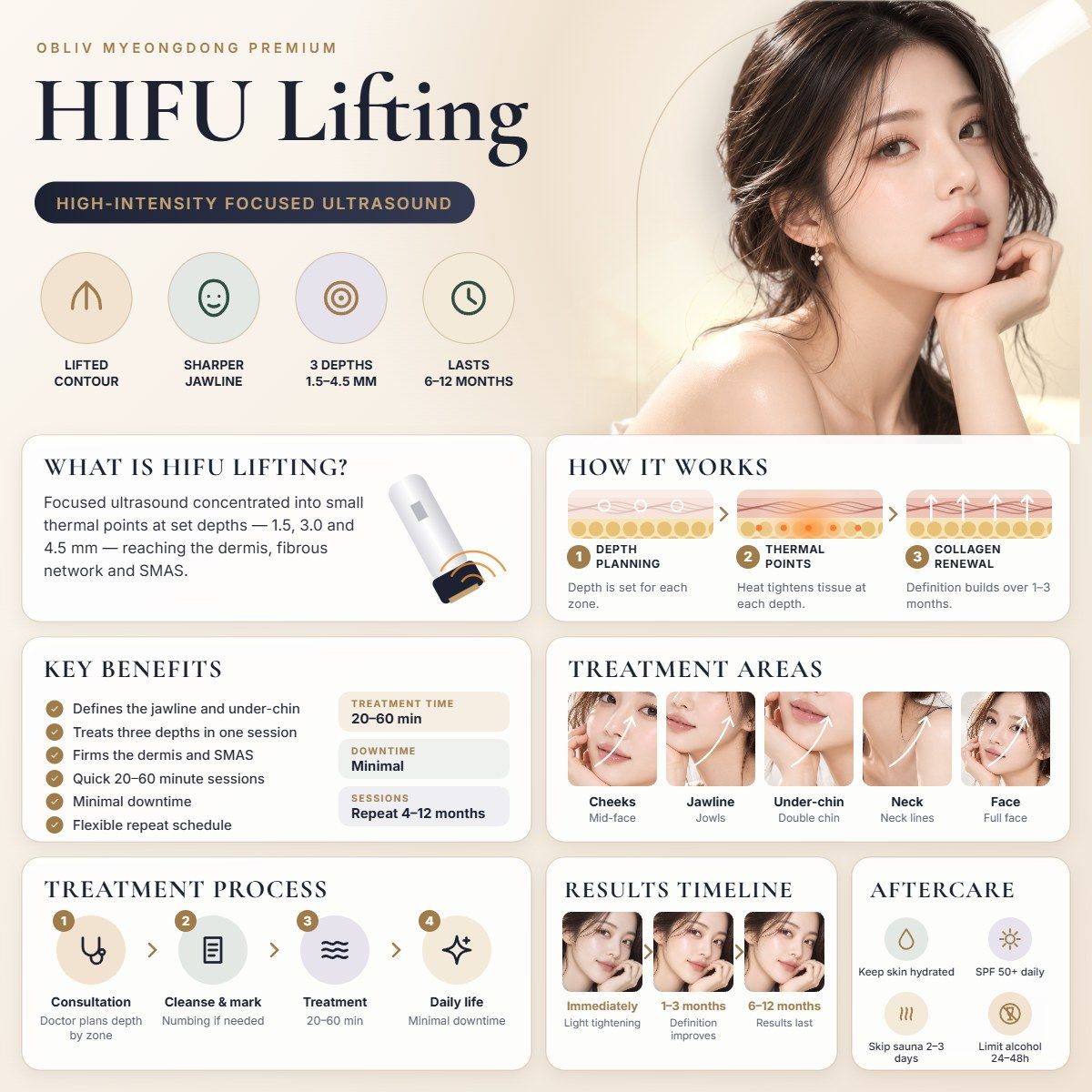
HIFU (high-intensity focused ultrasound) lifting is a non-invasive treatment that concentrates ultrasound into small thermal points at set depths — typically 1.5, 3.0 and 4.5 mm — reaching the dermis, the fat's fibrous network and the SMAS. The heat tightens tissue and stimulates collagen, defining the jawline and under-chin. At Obliv Clinic near Myeongdong and Jongno, Seoul, a doctor plans depth by zone; sessions take about 20–60 minutes, downtime is minimal, results build over 1–3 months and usually last around 6–12 months.

Time20–60 min depending on areas
DowntimeMinimal; tenderness for days
Sessions1 session; repeat every 4–12 months
LastsAbout 6–12 months (varies)

Key takeaways

  • "HIFU" is a device class, not a single brand. Ultherapy is one HIFU-type device with live imaging; Korean-made platforms such as Shurink (Ulfit/Ultraformer family) and Doublo are other well-known examples.
  • Depth selection matters more than the device name: 4.5 mm for SMAS lift, 3.0 mm for deep dermis and fat septa, 1.5 mm for superficial firmness.
  • HIFU is particularly good for jawline definition and under-chin fullness; it can also slightly reduce small fat pockets.
  • Expect prickly, deep heat along the bone, mild tenderness for days, and usually no visible marks.
  • Very thin faces, recent fillers in the same zone and severe laxity need a different or more careful plan.

What is HIFU lifting and how does it work?

High-intensity focused ultrasound works like a magnifying glass for sound. A transducer shapes ultrasound waves so they converge at a single small point below the surface; there the energy turns into heat, creating a tiny coagulation zone while the skin surface above stays intact. By firing rows of these points at a chosen depth, the device builds a thin plane of controlled heat injury that contracts tissue immediately and stimulates new collagen over the following weeks.

In aesthetic medicine HIFU was first developed for face and neck lifting in the late 2000s, and Korea has since become one of the world's biggest markets for it. Korean-made platforms are widely used in Seoul clinics, which is one reason HIFU ("하이푸" or simply "리프팅") is a regular part of skincare routines here rather than a once-in-a-decade procedure.

A useful way to think about HIFU is that it is a family of devices, not a brand. Ultherapy is a premium HIFU-type system with live imaging; Korean platforms such as the Shurink and Ulfit/Ultraformer families and Doublo are other well-known examples of the same class. Your doctor will always tell you exactly which device is used for your treatment and why.

HIFU Lifting at a glance Treatment time: 20–60 min depending on areas; Comfort / numbing: Numbing cream; prickly heat lines; Downtime: Minimal; tenderness for days; Typical sessions: 1 session; repeat every 4–12 months; Results appear: Some at once; builds over 1–3 months; Results last: About 6–12 months (varies) AT A GLANCE · OBLIV MYEONGDONG HIFU Lifting TREATMENT TIME 20–60 min depending on areas COMFORT / NUMBING Numbing cream; prickly heat lines DOWNTIME Minimal; tenderness for days TYPICAL SESSIONS 1 session; repeat every 4–12 months RESULTS APPEAR Some at once; builds over 1–3 months RESULTS LAST About 6–12 months (varies)
HIFU Lifting at a glance at Obliv Myeongdong. Ranges are typical; your doctor confirms them for your skin.

Depths and layers: 1.5, 3.0 and 4.5 mm explained

HIFU cartridges each focus at one fixed depth. The 4.5 mm depth sits around the SMAS, the fibromuscular layer a surgeon lifts in a facelift; 3.0 mm reaches the deep dermis and the fibrous septa that run through facial fat; and 1.5 mm targets the mid dermis for surface firmness. Some newer systems add 2.0 mm or 6.0 mm and 9.0 mm body depths, but the face is mostly treated with the three classic depths.

Obliv's Skin Architecture method uses those depths deliberately. A heavy jowl may need more 4.5 mm lines along the jaw with lighter 3.0 mm passes, while a slim face with crepey skin may need almost no deep work at all. Because skin and fat thickness vary across one face, your doctor adjusts depth zone by zone rather than running the same pattern over everything.

Which skin layer HIFU Lifting targets smas: 4.5 mm cartridges place heat points in the SMAS to tighten the lower face and jaw structure.; fat: 3.0 mm points reach the fibrous septa and can slightly reduce small fat pockets under the chin.; dermis: 1.5–3.0 mm points firm the mid and deep dermis for smoother, tighter-feeling skin. SKIN ARCHITECTURE · TARGET LAYER MAP Epidermis 0.05–0.1 mm Dermis (collagen & elastin) 1–3 mm 1.5–3.0 mm points firm the mid and deep dermis for smoother, tighter-feeling skin. Subcutaneous fat 3–4.5 mm+ 3.0 mm points reach the fibrous septa and can slightly reduce small fat pockets under the chin. SMAS (fibromuscular layer) ≈ 4.5 mm 4.5 mm cartridges place heat points in the SMAS to tighten the lower face and jaw structure. Muscle deeper Schematic, not to scale. Depths vary by face area, age and skin type; your doctor sets them after examination.
Skin Architecture view: the layers HIFU Lifting works on.

Areas we treat with HIFU

HIFU is strongest in the lower face, where there is enough soft tissue for the energy to work and where small improvements in definition make a visible difference. Published studies in Korean patients found it particularly effective for the jawline, cheeks and the area around the mouth.

  • Jawline and jowls — sharpens the jaw angle and reduces the soft drop below the jaw; see sagging skin and jowls.
  • Under-chin — tightens tissue and can modestly reduce small fat pockets; compare double chin injections.
  • Cheeks and nasolabial area — firms the mid-face and softens heaviness beside the smile lines.
  • Neck — improves mild looseness on the upper neck.
  • V-line contouring — often combined with jaw Botox; see non-surgical face slimming.

Patient's jawline profile before HIFU lifting at a Myeongdong skin clinic
HIFU works best in the lower face, where definition matters most.

Ask a doctor about HIFU Lifting

Send a photo and your travel dates on WhatsApp (+82-10-3086-4084). English replies, a personal plan and a written quote before you fly.

HIFU vs Ultherapy, Thermage and ONDA

The biggest practical difference between generic HIFU and Ultherapy is imaging: Ultherapy shows the layers live, so depth can be confirmed in every zone, while most HIFU devices rely on the doctor's anatomy knowledge and fixed cartridges. HIFU sessions are often lighter and repeated more frequently. Thermage uses radiofrequency to firm the dermis rather than lift deep, and ONDA uses microwaves to contour fat. Our skin tightening overview shows when each is the better first step.

Option How it works Imaging Typical strength Good for
HIFU (device class) Focused ultrasound at fixed cartridge depths Usually no live view Moderate; often repeated Jaw definition, under-chin
Ultherapy Microfocused ultrasound with visualisation Yes, real-time Strong structural lift Brow, jowls, neck
Thermage FLX Monopolar RF bulk heating No Firmness and skin quality Crepey skin, eyes, slim faces
ONDA lifting Microwave energy to fat layer No Contouring of fat Full cheeks, jowl fat
Double chin injections Injected fat-dissolving solution Not applicable Fat reduction Distinct submental fat

Who is a good candidate for HIFU?

HIFU suits adults with early to moderate lower-face laxity and enough tissue to treat, from the late twenties onwards for prevention and maintenance. Because heat at 3.0 and 4.5 mm can also reduce a little fat, we are careful in people whose faces are already slim or hollow; for them, firming the dermis with RF or improving skin quality with a skin booster is often wiser. Non-surgical lifting cannot replace a facelift for advanced sagging, and we will say so if that is your situation.

Who HIFU Lifting suits, and who should consider another option Good fit: Early jowls or a softening jaw angle; Mild fullness under the chin with fair skin elasticity; Wanting a firmer lower face with little downtime; Regular maintenance between stronger lifting treatments; Thicker skin with some fat to work on. Not ideal: Very slim or hollow faces where fat loss would age the look; Fresh fillers or threads in the area within recent weeks; Pregnancy, open wounds or infection in the zone; Severe laxity with hanging folds (surgery may suit better); History of facial nerve problems without prior review. ✓ Usually a good fit ✕ Discuss other options first Early jowls or a softening jaw angle Mild fullness under the chin with fair skin elasticity Wanting a firmer lower face with little downtime Regular maintenance between stronger lifting treatments Thicker skin with some fat to work on Very slim or hollow faces where fat loss would age the look Fresh fillers or threads in the area within recent weeks Pregnancy, open wounds or infection in the zone Severe laxity with hanging folds (surgery may suit better) History of facial nerve problems without prior review
Is HIFU Lifting right for you? A doctor confirms suitability at consultation.

Your HIFU appointment step by step

HIFU feels like a line of short, prickly heat pulses, sometimes with a deep ache when the beam is near bone. It is usually more comfortable on the cheeks than along the jaw. The doctor can switch to a shallower cartridge or lower energy in sensitive areas; a well-placed moderate treatment gives better results than one you can barely tolerate.

  1. Before you fly: send front and side photos and your travel dates on WhatsApp; mention any recent filler, threads or lifting.
  2. Mark-Vu imaging and consultation: the doctor examines skin thickness, fat and bone structure and agrees zones, depths and line counts in writing.
  3. Numbing: cream is applied for about 30 minutes; make-up is removed.
  4. Treatment: gel is applied and the doctor delivers rows of focused points zone by zone, checking comfort and adjusting energy. A lower face usually takes 20–40 minutes.
  5. Aftercare: gel is cleaned away, moisturiser and sunscreen applied, and you receive written care instructions plus a WhatsApp contact.
Your visit to Obliv Myeongdong in five steps: WhatsApp – Send photos, concerns and travel dates in English; Mark-Vu analysis – Imaging of pigment, redness, pores and texture; Doctor consult – Layer-by-layer plan, dose and written quote; Treatment – Private room, numbing and comfort checks; Aftercare – Written care plan and WhatsApp follow-up
How a visit to Obliv Clinic Seoul Origin works, from first WhatsApp message to aftercare.

Results and recovery timeline

Some tightening may be felt on the day, but the defined jawline people look for comes as collagen remodels over one to three months. Take photos in the same light before treatment and again at about three months to judge the change fairly.

Because many HIFU plans are lighter than a full Ultherapy treatment, results typically last around six to twelve months. In Korea many people book short maintenance sessions every four to six months, alternating with RF or boosters, rather than waiting for the effect to fade completely.

HIFU Lifting recovery and results timeline Day 0: Faint redness for under an hour; jawline may already feel slightly tighter.; Day 1–5: Mild swelling or soreness when touching or chewing; small bruises over bone are possible.; Week 2–4: Tenderness has settled; collagen remodelling is underway beneath the surface.; Month 1–3: Jawline, cheeks and under-chin look gradually firmer and more defined.; Month 3: Close to peak result for most plans. A good point for review photos.; Month 6–12: Effect gradually softens; lighter maintenance sessions keep results steady. RECOVERY & RESULTS TIMELINE 1 Day 0 Faint redness for under an hour; jawline may already feel slightly tighter. 2 Day 1–5 Mild swelling or soreness when touching or chewing; small bruises over bone are possible. 3 Week 2–4 Tenderness has settled; collagen remodelling is underway beneath the surface. 4 Month 1–3 Jawline, cheeks and under-chin look gradually firmer and more defined. 5 Month 3 Close to peak result for most plans. A good point for review photos. 6 Month 6–12 Effect gradually softens; lighter maintenance sessions keep results steady.
What to expect after HIFU Lifting, day by day.

HIFU for travellers: timing around flights and events

HIFU leaves no wound, so it fits easily into a city break. Most visitors go straight back to shopping in Myeongdong or walking around Jongno, and flying a day or two later is generally fine. The main side effect to plan for is jaw tenderness for a few days, so soft foods on the flight are a good idea. Our guide to tourist-friendly lifting procedures in Seoul explains how to fit lifting into a short trip.

For an event, book HIFU four to eight weeks ahead so the effect has started to show. If you only have a few days, a booster or carefully dosed Botox may be more useful in the short term.
Friends shopping in Myeongdong, Seoul, after a no-downtime HIFU session
Minimal downtime: most visitors head straight back to shopping or sightseeing.

Combining HIFU with RF, Botox and boosters

HIFU is often one layer of a broader plan. Ultrasound lifts at depth, radiofrequency such as Thermage firms the dermis, and boosters improve the surface. When combined on the same day, ultrasound usually comes first. This layered approach underpins our non-surgical facelift.

For a V-line, HIFU along the jaw and under-chin is frequently combined with masseter Botox, which slims a wide jaw muscle. Fillers and threads should be discussed beforehand; we usually leave several weeks between filler and HIFU in the same zone. Read combination RF lifting treatments in Seoul for how these plans are sequenced.

HIFU price in Seoul: what affects cost

HIFU prices in Seoul vary widely because devices, cartridge depths and line counts vary. A low headline price may cover only a few hundred lines on one area, while a full lower-face and neck plan uses many more. Compare quotes by device, number of lines and zones rather than by the word "HIFU" alone.

We give a written quote after consultation, record the device, depths and lines in your Skin Library and do not change the plan on the day without your agreement. See prices and payment for how international patients pay, and our tax refund update on the end of Korea's cosmetic VAT refund for foreign visitors on 31 December 2025.

Risks, side effects and safety

Every medical aesthetic treatment carries some risk. These are the effects our doctors explain before you consent:

  • Faint redness for under an hour and mild swelling for a day or two.
  • Tenderness, soreness when chewing or a bruised feeling along the jaw for several days.
  • Small bruises or raised welts, especially over bone.
  • Temporary tingling or numbness that usually resolves over days to weeks.
  • Rarely, temporary weakness of a small facial nerve branch, or small burns, if energy is placed too shallow or near danger zones.
  • Unwanted volume loss in very thin faces if deep cartridges are overused.
Seek medical help promptly if you notice severe or worsening pain, skin turning white, grey or dusky, blisters, spreading redness, fever, or any change in vision. Message the clinic on WhatsApp, and in an emergency in Korea call 119.

Aftercare checklist

  1. Use a gentle cleanser, plain moisturiser and sunscreen for the first few days.
  2. Avoid saunas, jjimjilbang and hot yoga for 1–2 days.
  3. Pause retinoids and exfoliating acids for 2–3 days if the skin is sensitive.
  4. Choose soft foods if the jaw is tender and avoid strong facial massage for a week.
  5. Make-up can usually be applied the same day.
  6. Message us on WhatsApp with a photo if you notice welts, lasting numbness or any change in your smile.

Frequently asked questions

How long does HIFU lifting last?

Typically about 6–12 months, depending on the device, the number of lines, your age and lifestyle. Many people book lighter maintenance every 4–6 months.

Is HIFU the same as Ultherapy?

Ultherapy is a type of focused ultrasound device with real-time imaging. 'HIFU' usually refers to the broader class of focused ultrasound lifting devices, many of which work at fixed depths without a live view.

Which HIFU device do you use?

Your doctor tells you which device is used and why at consultation, and records it in your Skin Library. The choice of depth and line count matters more than the brand name.

Does HIFU hurt?

It feels like prickly heat with a deep ache near bone. Numbing cream and adjusting depth or energy keep most people comfortable.

Can HIFU reduce a double chin?

HIFU can tighten the under-chin and slightly reduce small fat pockets. Distinct fat may respond better to double chin injections or a combination.

Can HIFU make my face look hollow?

In already slim faces, overuse of deep cartridges can reduce fat. That is why depth is chosen zone by zone, and why some people are better suited to RF tightening.

How soon can I fly after HIFU?

There is no wound, so flying the next day is generally fine. Expect some jaw tenderness for a few days.

Can I have HIFU after fillers?

Usually yes, but we generally wait several weeks after filler in the same zone and may avoid deep depths directly over it. Tell the doctor when and where you had filler.

Do you offer HIFU consultations in English?

Yes. English consultations are available, and you can message us on WhatsApp at +82-10-3086-4084 before you travel.

From the Obliv Skin Journal

Ask a doctor about HIFU Lifting

Send a photo and your travel dates on WhatsApp (+82-10-3086-4084). English replies, a personal plan and a written quote before you fly.

O
Medically reviewed by the Obliv Clinic Seoul Origin medical team
Our five physicians plan every treatment by skin layer using the Obliv Skin Architecture method. Last reviewed 2026-10-27. This page is general information, not a diagnosis; your plan is set after an in-person consultation.

Sources and further reading

  1. High-intensity focused ultrasound for the treatment of wrinkles and skin laxity in seven different facial areas – Annals of Dermatology, 2015
  2. A systematic review of the efficacy of microfocused ultrasound for facial skin tightening – Int J Environ Res Public Health, 2023
  3. American Academy of Dermatology – Many ways to firm sagging skin
  4. American Society for Dermatologic Surgery – Non-invasive skin tightening treatments

Explore Botox and fillers by area

Each area has its own anatomy, doses and safety rules. Choose an area for a doctor-reviewed guide with an infographic, typical doses, recovery and FAQs.

Botox by area · overview

Dermal fillers by area · overview

Every plan is made by one of our doctors after an in-person examination.