Golden Ratio Facial Assessment
Golden Ratio Facial Assessment
A golden ratio facial assessment uses mathematical proportions to examine relationships between different facial measurements. The golden ratio, approximately 1.618, has historically been discussed in facial aesthetics as a possible reference for facial harmony.
However, the golden ratio should not be treated as a universal formula for an attractive face. Research has found that many facial measurements do not consistently follow 1.618, and evidence linking the golden ratio directly with facial attractiveness remains limited and inconsistent.
Today, facial assessment is better understood as a broader evaluation of facial proportions, symmetry, features, anatomy, and individual characteristics rather than a calculation based on one mathematical number.
What Is a Golden Ratio Facial Assessment?
The golden ratio is a mathematical relationship in which the ratio between two lengths is approximately 1.618 to 1.
In facial aesthetics, this concept has been applied to measurements involving areas such as:
- Facial height and width
- Forehead, midface, and lower-face proportions
- Eye spacing
- Nose and mouth relationships
- Lip proportions
- Chin and lower-face dimensions
- Relationships between facial landmarks
A facial assessment may use photographs, direct measurements, or digital facial-analysis systems to examine these relationships.
The purpose is generally to understand facial proportions rather than simply determine whether a person is “attractive” or “unattractive.”
Does the Golden Ratio Define an Ideal Face?
No. Current evidence does not support using the golden ratio as a universal definition of ideal facial beauty.
A systematic review published in the Journal of Prosthetic Dentistry found that facial measurements did not consistently follow the golden proportion and found no significant association between the golden ratio and facial evaluation scores across the ethnicities included in the reviewed research.
Another study using three-dimensional facial measurements found that most of the examined facial ratios were statistically different from 1.618 and that the measured ratios were not associated with attractiveness.
Research has also identified differences in facial measurements among ethnic and gender groups, suggesting that applying one fixed proportional standard to every face has important limitations.
What Is Measured During Facial Analysis?
Vertical Facial Proportions
The face can be assessed vertically by examining relationships between the upper, middle, and lower portions of the face.
Clinicians may consider the relative position of the forehead, nose, lips, and chin. These measurements can help describe whether certain facial areas appear relatively longer or shorter.
Importantly, a difference from a mathematical reference does not automatically indicate a problem or mean that treatment is necessary.
Horizontal Facial Proportions
Horizontal assessment may examine facial width and relationships between features such as the eyes, nose, cheeks, and mouth.
Facial width can vary naturally according to bone structure, soft tissue, age, sex, and ancestry. Research has demonstrated substantial variation in these measurements between populations.
Facial Symmetry
Symmetry is another commonly discussed component of facial assessment.
Human faces are not perfectly symmetrical, and small differences between the left and right sides are normal. A facial assessment may therefore consider asymmetry as one part of the overall picture rather than expecting complete mirror-image symmetry.
Facial Profile and Projection
A profile assessment can examine relationships between the forehead, nose, lips, chin, and jaw.
This may be relevant when evaluating facial balance or considering aesthetic treatment. Depending on the individual's concern, soft-tissue proportions and underlying skeletal structure may both need to be considered.
Golden Ratio Assessment vs. Comprehensive Facial Analysis
A golden ratio assessment focuses on specific mathematical relationships. A comprehensive facial analysis considers a much wider range of factors.
A broader assessment may include:
- Facial proportions
- Symmetry
- Facial shape
- Feature size and position
- Chin and jaw projection
- Nose and lip relationships
- Skin and soft-tissue characteristics
- Age-related changes
- Individual aesthetic preferences
This broader approach is particularly relevant when facial analysis is being used to discuss potential cosmetic treatment.
The available evidence suggests that facial beauty cannot be reliably reduced to one mathematical formula. Reviews of quantitative facial aesthetics have similarly concluded that there is still no definitive formula explaining human facial attractiveness.
Golden Ratio Facial Assessment in Korea
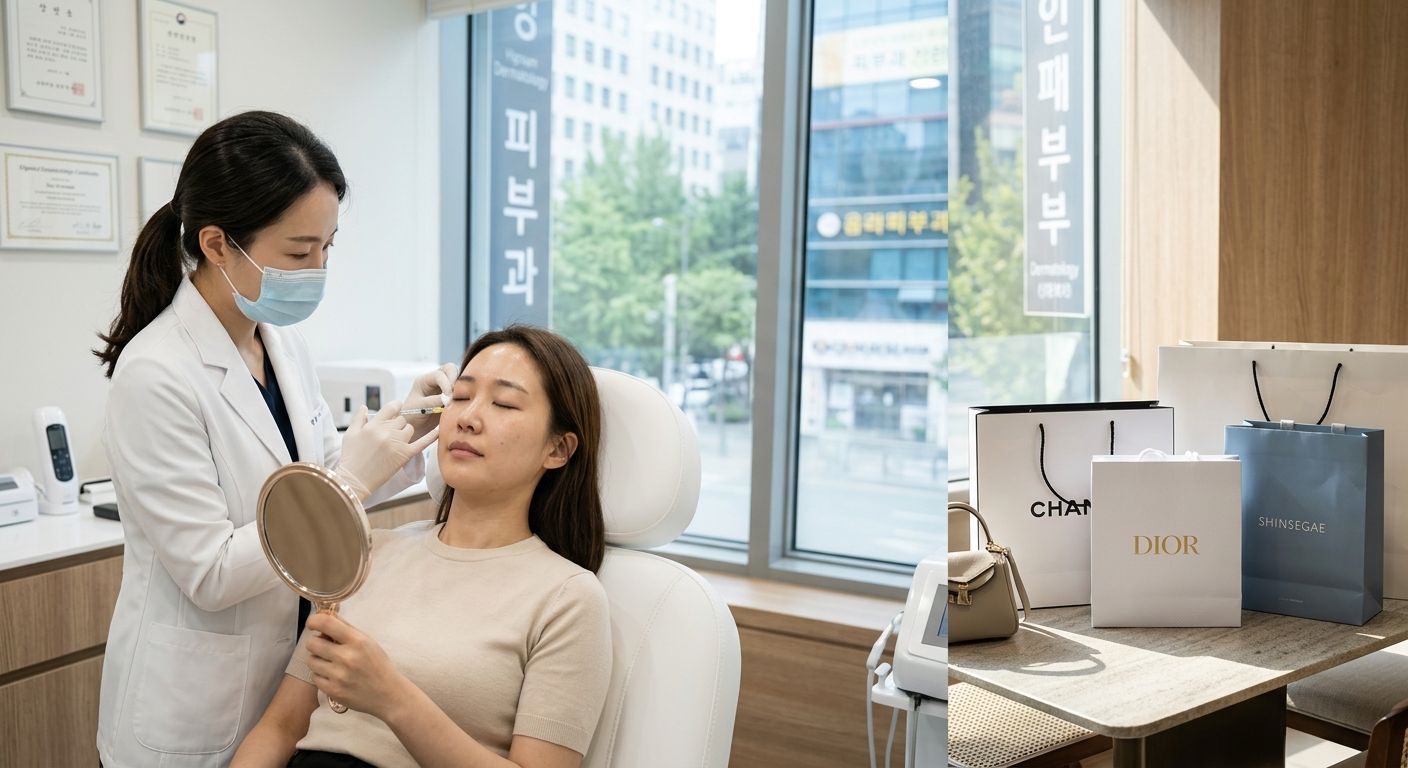
Facial analysis may be discussed during consultations for aesthetic treatments in South Korea, including procedures involving facial contouring, fillers, botulinum toxin, skin treatments, or other cosmetic approaches.
For international patients, it is useful to ask whether a provider's assessment is based solely on a golden-ratio calculation or includes a broader clinical evaluation.
A consultation may be more useful when it considers the patient's:
- Natural facial anatomy
- Existing facial proportions
- Desired degree of change
- Previous cosmetic treatments
- Skin and soft-tissue characteristics
- Relevant medical history
- Expectations about the result
Patients should also understand that a measurement outside a particular reference range does not automatically mean that correction is medically or aesthetically necessary.
Can Golden Ratio Analysis Help With Treatment Planning?
It can provide one descriptive framework for discussing facial proportions, but it should not be used as the sole basis for treatment planning.
For example, an injectable treatment should not be recommended simply because a particular measurement differs from 1.618. Treatment decisions should consider anatomy, safety, the patient's goals, and whether the proposed intervention can realistically produce the desired change.
The same principle applies to surgical planning. Recent literature has questioned the evidence supporting the golden ratio as a standard for facial aesthetic or orthognathic surgical planning.
Limitations of Golden Ratio Facial Assessment
The main limitation is that human facial structure is highly variable.
Differences can occur between individuals and populations, and facial proportions can change with age, sex, skeletal structure, soft-tissue distribution, and other characteristics.
There is also a difference between measuring a proportion and proving that the proportion determines attractiveness. A face can differ substantially from 1.618 and still be perceived as harmonious or attractive.
For this reason, golden ratio analysis is best viewed as a measurement concept rather than a definitive beauty test.
Frequently Asked Questions
What is the golden ratio of the face?
The golden ratio is approximately 1.618. In facial analysis, it describes proposed relationships between selected facial measurements.
Is 1.618 the ideal facial ratio?
Not necessarily. Scientific research has not established 1.618 as a universal ideal for human facial proportions or attractiveness.
Can I calculate my facial golden ratio from a photograph?
A photograph can be used for basic proportional measurements, but camera angle, lens distortion, facial position, and image quality can affect measurements. Professional facial analysis may use standardized photographs or three-dimensional imaging when appropriate.
Does facial asymmetry mean my face is unattractive?
No. Mild facial asymmetry is common. Facial appearance involves many characteristics, and symmetry alone does not determine attractiveness.
Is golden ratio analysis useful before cosmetic treatment?
It may help describe certain facial proportions, but it should not be the only factor used when considering treatment. A broader assessment of anatomy, goals, risks, and expected outcomes is more appropriate.
Can international patients get facial analysis in Seoul?
Yes, facial aesthetic consultations are available in Seoul. International patients should ask what measurements and assessment methods are used and ensure that any recommended treatment is based on an individualized professional evaluation rather than a single mathematical standard.