Beauty Treatments That Require Almost No Downtime

Quick answer
Beauty treatments with almost no downtime are those that let you return to normal plans within hours: needle-free LDM ultrasound, medical-grade hydrating facials, gentle toning lasers, small-dose Botox and, with a day's buffer, hydrating skin boosters such as Skinvive or Rejuran. In Seoul, a doctor-led clinic near Myeongdong and Jongno can combine one or two of these in a single visit. "Almost no downtime" still means short-term care: sunscreen, no sauna or heavy drinking for a day, and realistic, gradual results.
Key takeaways
- The gentlest options are LDM ultrasound, calming medical facials and gentle toning lasers: back to normal within hours.
- Small-dose Botox leaves only pinpoint marks but takes several days to work, so plan it ahead of events.
- Hydrating skin boosters usually leave small bumps for hours to a day; book them the day before a lighter day.
- Low downtime is not no risk: bruising, redness and rare reactions still happen, so a doctor should assess you first.
- Bigger changes, such as deep scars or significant sagging, usually need treatments with more recovery time.
What "almost no downtime" really means
In clinic language, downtime is the period after a treatment when you would rather not be seen in public, or when you need to avoid normal activities. Deep chemical peels and ablative lasers can mean a week or more of redness and peeling. Low-downtime treatments, by contrast, let you go back to work, shopping or dinner the same day, sometimes within minutes.
That does not mean nothing happens to the skin. Most effective treatments cause some short-lived reaction: a little pinkness after a laser, pinpoint marks after an injection, small bumps after a booster. The difference is that these settle within hours to a day and are easy to cover with light make-up. There may also be a few activities to avoid briefly, such as saunas, intense exercise and heavy drinking.
For visitors to Seoul with packed itineraries, low-downtime options are often the most practical choice. This guide explains the main types, what each can realistically achieve, and when a treatment with more downtime would serve you better.
The gentlest options: no needles, no visible recovery
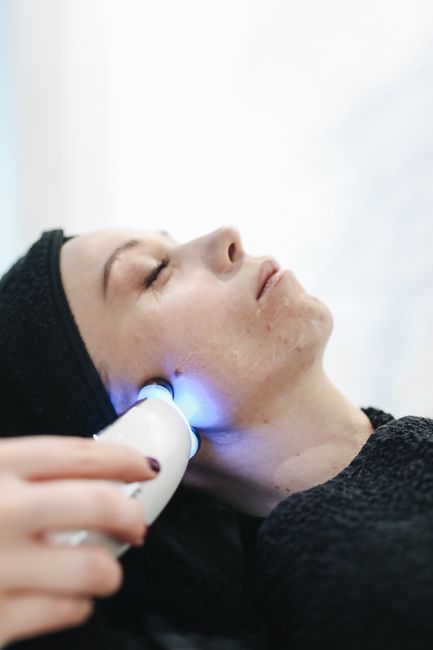
LDM skin regeneration uses dual-frequency ultrasound to calm and hydrate the skin. It is painless for most people, leaves no visible marks, and suits sensitive or redness-prone skin, as well as travellers recovering from a long flight. Results are subtle but immediate, and they build with repeated sessions.
Medical-grade hydrating and cleansing facials sit in the same category. The American Academy of Dermatology notes that some facial treatments sold in spas can irritate skin or spread infection if hygiene is poor, so it helps to have them in a medical setting where a doctor checks your skin first and can adjust the plan for acne, rosacea or sensitivity. Our redness and sensitive skin guide covers this in more depth.
Gentle lasers for tone and glow
Low-energy toning lasers, often picosecond or Q-switched devices used at gentle settings, are a staple of Korean clinics for uneven tone, early sun spots and a brighter look. Redness usually fades within a few hours, and many people return to work the same afternoon. The trade-off is that pigment improves gradually over a series of sessions rather than in one visit.
Stronger options such as fractional Pico Fraxel sit at the edge of "low downtime": a few days of pinkness or fine texture is common. They are excellent for pores and shallow scars, but plan them before a quieter day. If you have melasma, gentle and gradual is essential, because aggressive lasers can make it worse; see our hyperpigmentation treatment page.
Ask a doctor about low-downtime treatments
Send a photo and your travel dates on WhatsApp (+82-10-3086-4084). English replies, a personal plan and a written quote before you fly.
Injectables with minimal downtime
Small-dose Botox or Xeomin for forehead, frown or crow's-feet lines takes only minutes. Apart from pinpoint marks and the occasional small bruise, there is little to see. The key point is timing: botulinum toxin starts working after a few days and reaches its full effect at about two weeks, so it is best done well ahead of an event.
Hydrating skin boosters such as Skinvive and polynucleotide boosters such as Rejuran involve many tiny injections. Small raised bumps usually settle within hours to a day, which is why we class them as low rather than no downtime. Results build over one to four weeks and improve with a series.
Dermal fillers can also be low downtime in experienced hands, but swelling and bruising vary more, particularly in the lips and under-eyes. The FDA advises that fillers carry real, if uncommon, risks; we prefer patients to have a few days in Seoul after filler rather than flying straight home.
| Treatment | What it helps | Back to normal | Typical result timing |
|---|---|---|---|
| LDM ultrasound | Hydration, redness, sensitivity | Immediately | Same day, builds with sessions |
| Medical hydrating facial | Dull, dry skin; congestion | Immediately to a few hours | Same day |
| Gentle toning laser | Uneven tone, early pigment | A few hours | Gradual over a series |
| Small-dose Botox | Expression lines | Same day (pinpoint marks) | About 3–14 days |
| Hydrating skin booster | Dehydration, texture, fine lines | Hours to a day | About 1–4 weeks |
Is a low-downtime plan right for you?
Low-downtime treatments are ideal when your goal is to look fresher, more rested and more even, and when your schedule leaves no room for recovery. They are also a sensible first step if you are new to clinic treatments or have sensitive skin.
They are not designed to deliver dramatic change. Deep acne scars, significant sagging and long-standing pigment usually respond better to stronger treatments or a series, and some concerns are best addressed surgically. A doctor will tell you honestly when a gentle option is unlikely to meet your goal.
What a low-downtime visit looks like
At Obliv Clinic Seoul Origin, every visit starts with a doctor consultation and Mark-Vu imaging. Using our Skin Architecture method, the doctor looks at which layer is responsible for your concern, for example surface tone, dermal hydration or muscle-driven lines, and chooses the gentlest tool that can address it. Many plans combine one device treatment with one injectable, completed in about one to two hours.
The timeline shows what to expect in the hours and weeks afterwards. Most people walk out with mild redness that fades quickly. Botox and boosters keep improving over the following days, so it is worth leaving some time before judging the result.
Aftercare: small steps that protect the result
Aftercare for low-downtime treatments is simple, but it matters. Sun exposure on freshly treated skin can trigger pigment, and heat can increase redness and swelling. Following a few basic rules for the first day or two keeps the reaction short and protects the result.
If you notice anything unexpected, such as bruising that keeps spreading, a lump that is getting larger or skin that looks pale or dusky, message us on WhatsApp with a photo straight away.
- Apply broad-spectrum SPF 30+ before going outside, even on cloudy days.
- Use a gentle cleanser and plain moisturiser for a day or two; pause retinoids and exfoliating acids if advised.
- Avoid saunas, jjimjilbang, hot yoga and intense workouts for about 24 hours after lasers or injections.
- Do not rub, massage or press on injected areas the first day; sleep on your back that night.
- Keep alcohol light the first evening to reduce flushing and bruising.

Matching low-downtime options to common concerns
For dull, dehydrated skin, start with hydration: LDM or a calming facial on the day, and a hydrating booster if you have a free evening afterwards. For early fine lines on the forehead or around the eyes, small-dose Botox is usually the most efficient choice, provided you have a week or so before any big event. For uneven tone and the first sun spots, a short series of gentle toning laser sessions works better than one strong session, and daily sunscreen is part of the treatment rather than an extra.
Oily, congested skin and enlarged pores often improve with a combination of medical cleansing, a gentle laser and, for some people, small amounts of toxin placed superficially to reduce oil, sometimes called skin Botox; our article on skin Botox versus regular Botox explains the difference. Mild laxity along the jawline is a borderline case: radiofrequency lifting such as Thermage has little visible downtime but takes months to show its full effect, so think of it as low downtime with delayed reward.
Booking low-downtime treatments in Seoul
The clinic is between Myeongdong and Jongno, about a six-minute walk from Jongno 3-ga and Euljiro 3-ga stations, so a low-downtime appointment fits easily between sightseeing, shopping or meetings. English consultations are standard, and Chinese or Japanese support can be requested when booking. If you are unsure which option fits, you can start with the consultation alone and decide afterwards.
Send photos, your goals and your schedule on WhatsApp and we will suggest a plan and a written quote. Our guides to same-day cosmetic skin treatments and one-hour treatments before your flight have more ideas, and our prices and payment guide explains how quotes work.
Frequently asked questions
Which treatment has the least downtime?
Needle-free LDM ultrasound and calming medical facials usually have none at all. Gentle toning lasers leave mild redness for a few hours.
Can I wear make-up after a low-downtime treatment?
After LDM or a facial, usually straight away. After lasers or injections, wait a few hours if possible and use clean brushes and light products.
How soon will I see results?
LDM and facials give an immediate glow. Botox takes about 3 to 14 days, and hydrating boosters build over one to four weeks.
Is Botox really low downtime?
Yes. Most people have only pinpoint marks, sometimes a small bruise. The main thing to plan around is that it takes several days to work.
Are skin boosters low downtime?
Mostly. Small bumps usually settle within hours to a day, so book them before a lighter day or an evening at the hotel.
Can I combine two low-downtime treatments in one visit?
Often yes, for example LDM with Botox, or a toning laser with a booster. A doctor decides what is safe to combine for your skin.
Will low-downtime treatments fix deep scars or sagging?
Usually not on their own. They improve freshness and texture, but deeper concerns typically need stronger treatments or a longer plan.
Related treatments and guides
Keep reading
- Same-Day Cosmetic Skin Treatments in Myeongdong Seoul
- One-Hour Cosmetic Dermatology Treatments Before Your Flight from Seoul
- Lunch Break Skin Treatments Near Jongno Offices
- Medical Grade Facial Treatments in Myeongdong Korea
- Glass Skin Treatments Safe for Sensitive Skin
Ask a doctor about low-downtime treatments
Send a photo and your travel dates on WhatsApp (+82-10-3086-4084). English replies, a personal plan and a written quote before you fly.
Sources